

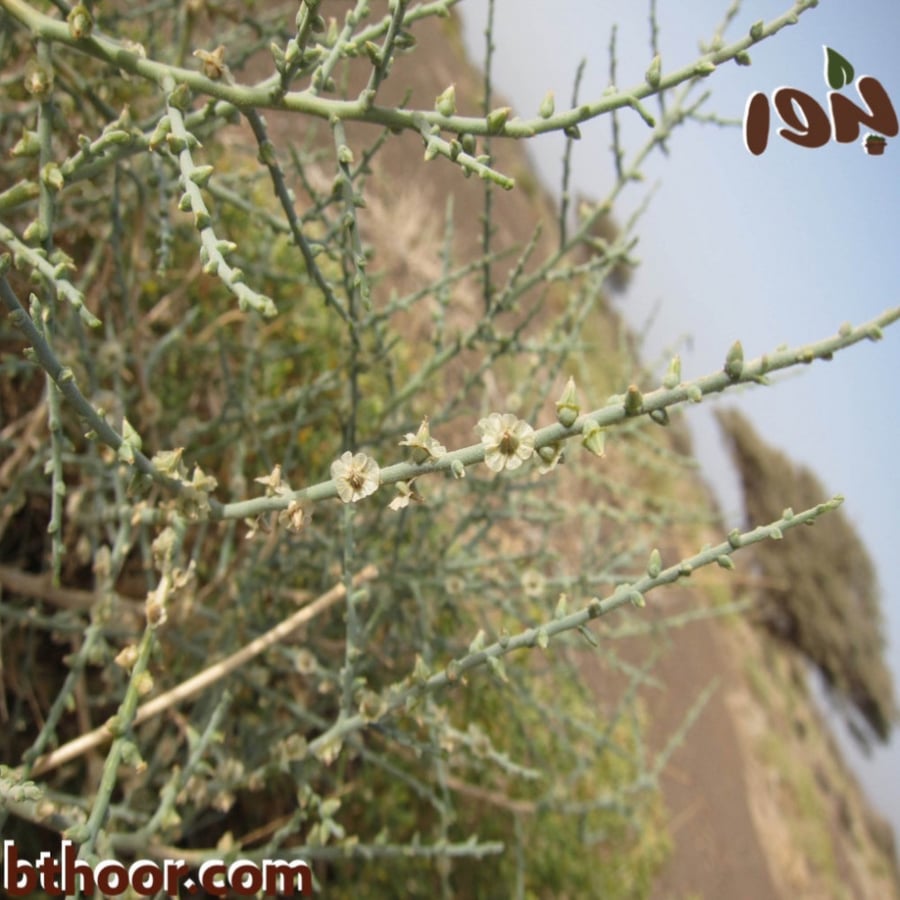
Halothamnus bottae
6ر.س
Product description
Common name: Al-Hadidah. Scientific name: Halothamnus bottae. Also called: Qidah - Al-Tahyan. Original habitat of Al-Hadidah (Al-Tahyan):
• Found in the Arabian Peninsula.
Description of Al-Hadidah (Al-Tahyan):
• Al-Hadidah or Al-Tahyan is a perennial wild herb that reaches up to 50 cm in height, with thorny branches and leaves spaced apart from the branches, shaped like triangles, and length of 0.7-3 (rarely 8) mm.
Description of the flower of Al-Hadidah (Al-Tahyan):
• Small yellowish-white flowers distributed along the stems, with a fragrant smell, blooming in spring.
Uses and benefits of Al-Hadidah (Al-Tahyan):
• Considered a good plant for feeding camels, horses, and sheep.
• Has many uses in the medical field.
• Used for beekeeping.
• Good for soil stabilization.
Suitable climate for Al-Hadidah (Al-Tahyan):
• Grows in hot climates.
• Tolerates various temperatures.
• Tolerates drought.
• Tolerates frost and cold.
Suitable soil for Al-Hadidah (Al-Tahyan):
• Grows in various soils.
• Grows in well-drained and aerated soils.
• Tolerates soil salinity.
• Grows and thrives in sandy soils.
• Grows in dry rocky and arid lands.
• Grows in low-lying, hot, arid lands up to 100 meters above sea level.
• Is irrigated regularly during germination periods.
Propagation method of Al-Hadidah (Al-Tahyan):
• Propagates by seeds.
Planting time for Al-Hadidah (Al-Tahyan):
• Planted in spring and summer.
Method of cultivating Al-Hadidah (Al-Tahyan):
• Can be cultivated indoors at home using pots, by planting several seeds in a pot filled with suitable soil, maintaining moisture through watering, and placing the pot in a sunny location.
Fertilization of Al-Hadidah (Al-Tahyan):
• A small amount of natural fertilizer or NPK fertilizer can be added to the soil during germination, which is sufficient.

From Buraydah