
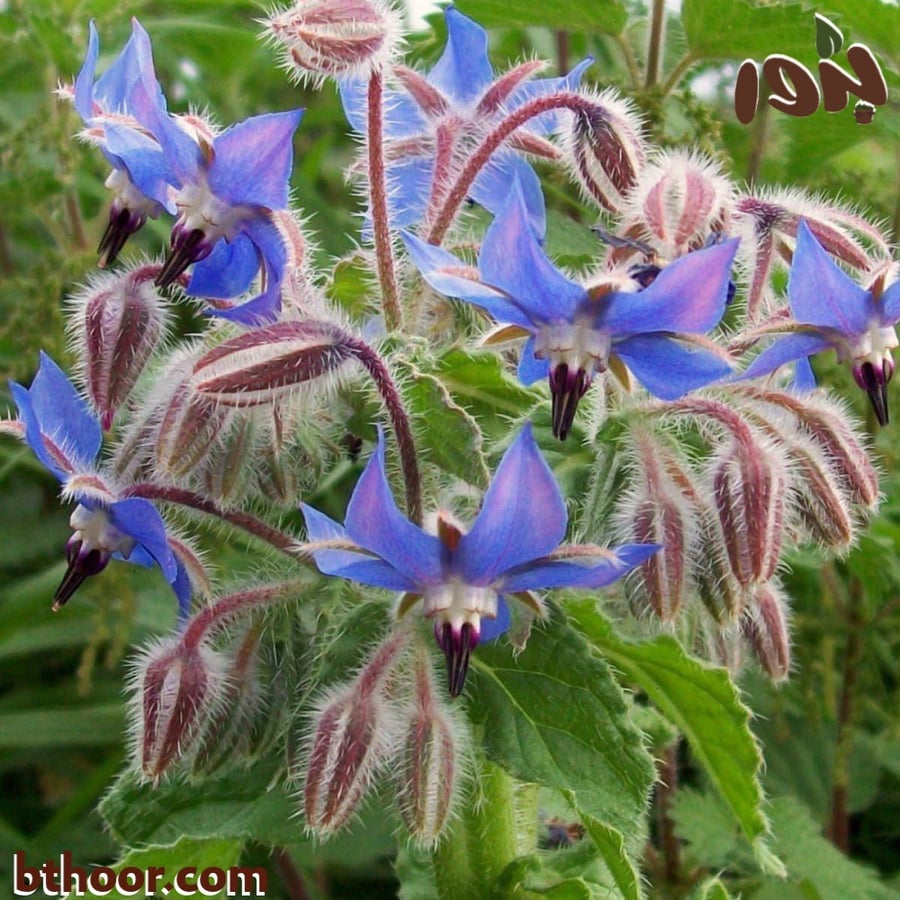


Bee bread seeds
7ر.س
Product description
Common name: Bee Bread
Scientific name: Borage officinalis
Also called: Abu Al-‘Araq - Lisan Al-Thawr - Al-Hamham - Al-Qas’ain Al-Bari.
Description:
• A wild annual herbaceous plant with green growth belonging to the Boraginaceae family, called Bee Bread due to its richness in nectar and pollen dust, which are considered among the best nutrients for worker bees and drone larvae. It has a hollow, succulent stem that reaches about one meter in length.
• Its leaves are oval-shaped, over 10 cm long, covered with dense hairs or fuzz that cause skin itching when touched.
• Bee Bread is considered one of the best pollinating plants grown near honeybee hives because of its dense flowers and high-quality honey.
Flowers:
• Small, not exceeding 2 cm in diameter, star-shaped, located at the tips of branches with three petals, brightly colored in blue or purple.
• Its high sugar concentration, presence of volatile oils, and fatty acids make it attractive to bees.
• Bee Bread is densely flowering and contains a large amount of pollen, which is rich in proteins needed by worker bees and drone larvae.
• It lasts for a long period, making it suitable for bees during times when nectar from flowers is scarce, from the beginning of the year until April.
• It is also distinguished by not falling off like some flowers after bee visits.
Uses and benefits:
• Has medicinal applications and is cultivated for bee feed, as bee swarms tend to forage heavily on this plant, resulting in higher honey production.
• It is cultivated near apiaries in England, France, the Levant, and recently in Egypt, due to its medicinal uses and benefits for honey and bees.
Suitable climatic conditions and soil for cultivation:
• Bee Bread is a winter wild plant that can tolerate low temperatures and moderate climates but does not withstand high temperatures.
• It can be cultivated in light clay soils, fertile yellow lands, and newly reclaimed lands.
• Due to the dense hairs or fuzz, Bee Bread is considered pest-resistant and can be grown without pesticides.
Original habitat:
• Its native region is the Alps and the Levant, and it is cultivated in Egypt, Saudi Arabia, and many Arab countries.
Fruit and seeds:
• Fruit: Green at the beginning of growth, turning dark brown when dried, with a hard, rough shell.
• Seeds: Located inside the ovary, which has 3 to 4 cavities; small, dark-colored, and retain viability for over five years.
Cultivation method:
• Propagated by seeds, with planting starting in September.

From Buraydah