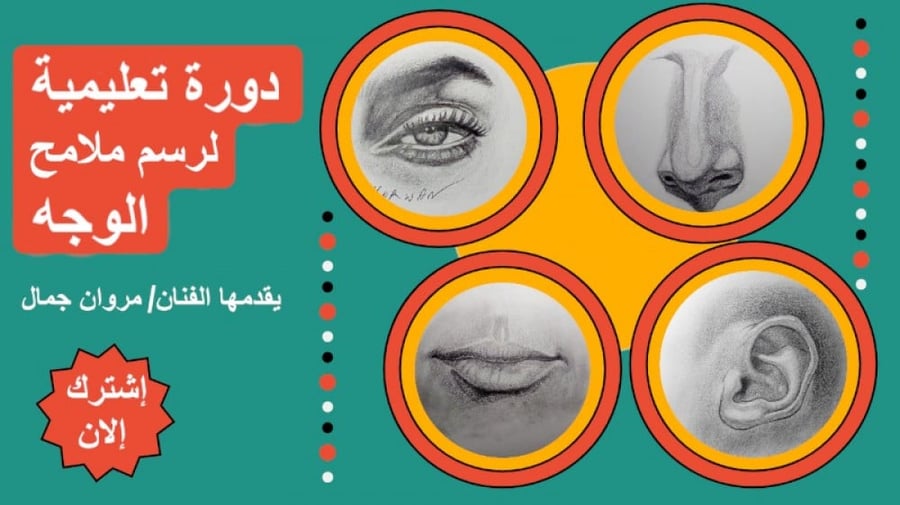
Learn to draw the four facial features
155ر.س
Product description
Imagine yourself holding a pencil or a paintbrush, sitting in front of a blank paper, ready to explore the world of art and achieve your creativity in drawing the four facial features correctly. If you aspire to become a skilled artist in drawing faces, then this exciting educational course is exactly what you need. This course is specially designed for those who want to acquire the basic skills to draw facial features professionally. You will discover the magic of art and learn the essential basics to accurately and artistically draw and depict the eye, nose, mouth, and ear. This educational journey will be an exciting exploration of detailed precision and advanced techniques that will help you achieve impressive drawings. Goals: acquire the necessary skills to draw the four facial features correctly and professionally. Understand the details of the structure and anatomy of the eye, nose, mouth, and ear. Develop the ability to focus and observe details carefully in face drawing. Ability to use appropriate techniques for light, shadows, and cavities in the face. Achieve balance and harmony in drawing facial features and maintaining correct proportions. Topics: The educational course in your hands lasts 59 minutes divided into 12 lessons as follows: In the first lesson, we will quickly review the parts that make up the eye, as well as learn how and where to place the eye in its appropriate position on the face space, and also understand the relationship between the eyelid and the eye, and how to draw the eyelid correctly and three-dimensionally. In the second lesson, we will review the parts of the eye in detail or more precisely, a detailed explanation of eye anatomy, and also learn how to form the eyebrow and eyelashes correctly. In the third lesson, we will start the practical part, where through five specific steps, you will learn how to draw the eye correctly from the planning stage to the final details. In the fourth lesson, we will begin explaining the nose, where you will learn how to place the nose as a cube and the purpose behind that, and also how the shape of the nose changes with head movement and the viewing angle. In the fifth lesson, you will learn in detail the anatomy of the nose and the parts it consists of, and the importance of this knowledge is that understanding the anatomy enhances your perception and awareness of existing details that almost emerge from under the skin. In the sixth lesson, you will learn to divide the shape of the nose into small surfaces because the nose is a complex shape, and it is important to train your eyes to simplify the nose shape while drawing. In the seventh lesson, we start the practical part, where through five specific steps, you will learn how to draw the nose correctly from the planning stage to the final details. In the eighth lesson, you will learn about the basic shapes of the mouth and also the muscular anatomy that forms the mouth area and helps us control lip movement. In the ninth lesson, you will learn about the external parts that make up the mouth and its surrounding area, as well as how to see the curvature of the mouth, the overlapping lines of the lips, and many other details. In the tenth lesson, we begin the practical part, where through five specific steps, you will learn how to draw the mouth correctly from the planning stage to the final details. In the eleventh lesson, you will learn all the details about the ear, such as its relation to the head from all directions and the parts it consists of, as well as a clever trick to simplify internal ear details, which many artists consider complex and difficult, and you will also learn the relationship between light and shadow with those details to make them easier to draw. In the twelfth and final lesson, we start the practical part, where through five specific steps, you will learn how to draw the ear correctly from the planning stage to the final details. I am eagerly waiting for you so we can start this enjoyable educational journey together. Required tools: Canvas paper or Vibriano (300 grams) or your preferred paper type for the student. Pencils (4H - B - 2B - 5B - 8B), generally the required pencils are mentioned during the explanation. Eraser. Target audience: Portrait artists. Animators. Comic and storyboard artists. Magazine cover and children’s story illustrators. Digital artists (digital), as the course will teach principles you can apply with any tool that suits you. Fine arts college students who lack comprehensive explanation in their educational curricula. ________________________________________________________________ Why buy from Artist Island? Online courses accessible from anywhere in the world once purchased. Courses are available for viewing immediately after purchase and at any time and in any number needed. Competitive prices and a focus on offering only the best. ________________________________________________________________ How to get the course files/videos? Log in to Artist Island store and go to "My Account". Click on "Orders". Click on the file links within the order number.

From Saihat