

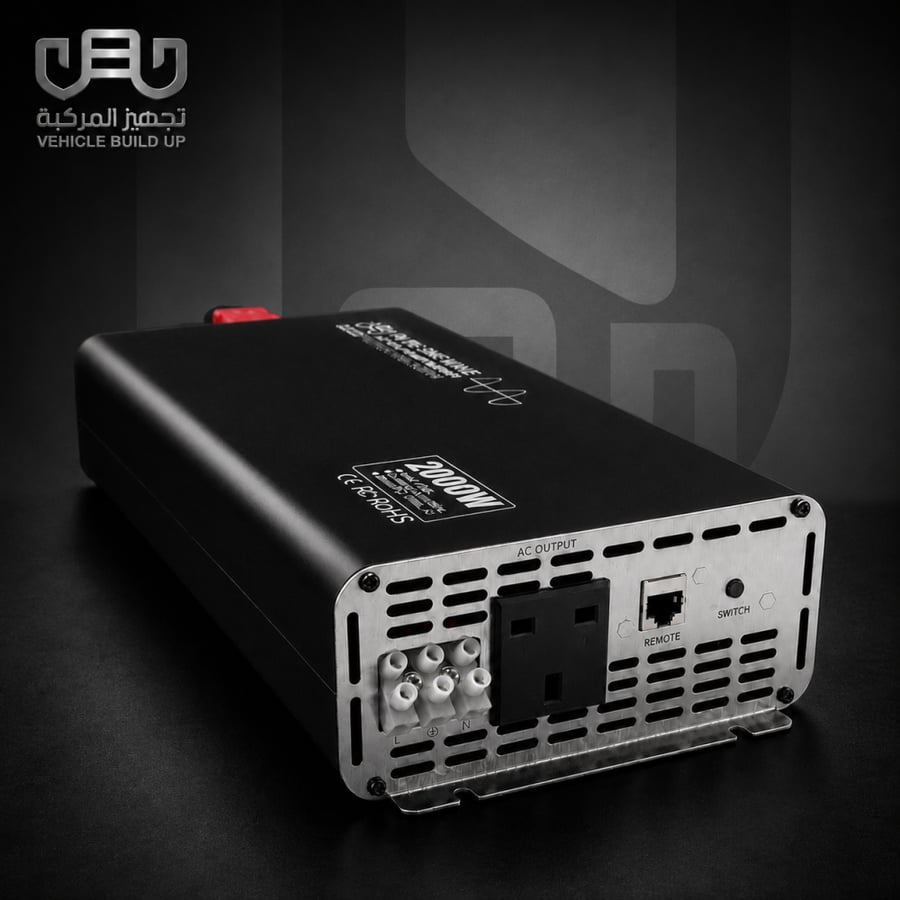


Pure power adapter from 12V to 220V
377.20ر.س


Product description
🔌 Pure Power Converter from 12V to 220V – Pure Wave 60Hz If you are a travel enthusiast, or use solar energy systems in your caravan or car, this converter is the perfect solution for you! It converts electricity from DC 12V to household AC 220V – 60Hz safely and efficiently, suitable for operating even sensitive devices. Vehicle equipment converter with pure wave and multiple sizes. Converts electricity from DC 12V to household AC 220V 60Hz. Suitable for cars and caravans and works on 12V batteries and 12V solar energy systems. Product description: High performance and exceptional flexibility: This converter provides high performance with the ability to adapt to loads even in overload conditions. It also features excellent resistance to electrical shocks, ensuring safe and reliable use. Advanced technology: The converter operates using sophisticated SPWM technology controlled by precise microcontrollers (MCU), generating pure sine wave current loops, ensuring stable and efficient performance in various applications. Applications: This converter is ideal for several devices including sensitive devices such as:- Coffee and espresso machines.- Microwave.- Medical devices. Smart information display: The converter is equipped with an information screen that shows you:- Input and output voltage.- Connected load level.- Warning alarm when loads increase or battery weakens, helping you monitor its performance continuously. Smart cooling system: The converter has a smart cooling system with two fans to ensure stable performance without affecting efficiency. Small size:- Features a small size allowing installation in tight spaces, such as under the mattress, saving you extra space. Multiple protection systems: The converter includes several protection systems to protect you from risks:- Overvoltage protection.- Low voltage protection.- Overload protection.- Overheat protection.- External current short circuit protection. Reliable and safe:- The converter is designed to operate with stable performance without affecting efficiency. - Operates quietly, enhancing comfort during use.- Shock resistant, ensuring greater safety during use in mobile environments.- Alerts in case of low battery voltage, high voltage, excessive heat, or overload. Operation in various temperatures: The converter works effectively in temperatures from -5°C to +80°C, making it suitable for use in different climates. Remote control connection guide: To turn on the device, press the power button. Enter pairing mode: press and hold the power button for about 5 seconds until the red light starts flashing. Complete pairing: press any button on the remote control to complete pairing. If successful, the flashing will stop or change color. Technical specifications: Available in different capacities as needed: 1. 300 watts (supports up to 330±50 watts): - Length: 18 cm - Width: 11 cm - Thickness: 5.6 cm - Note: this model does not include a display. 2. 600 watts (supports up to 660±50 watts): - Length: 20 cm - Width: 17.3 cm - Thickness: 7.6 cm 3. 1000 watts (supports up to 1100±50 watts): - Length: 31 cm - Width: 17.3 cm - Thickness: 7.6 cm 4. 2000 watts (supports up to 2200±50 watts): - Length: 36 cm - Width: 17.3 cm - Thickness: 7.6 cm 5. 3000 watts (supports up to 3300±50 watts): - Length: 40 cm - Width: 24.2 cm - Thickness: 8.8 cm Warranty: The converter comes with a 3-year warranty, ensuring peace of mind throughout its use. Illustrative video: The table shows how to choose the appropriate wire length based on wire size and electrical converter to ensure no voltage drop exceeds 3%. Let me explain the topic further, both technically and practically: What is voltage drop? Voltage drop means a decrease in electrical voltage as current passes through the wire. This drop occurs due to resistance in the wire, which can lead to: Negative impact on connected devices (such as the converter). Reduced efficiency in power transmission. The basic rule is that if the voltage drop exceeds 3%, there is energy loss that may affect the performance of the electrical system, such as the converters. How to calculate the appropriate wire length? The table provides a simple formula for choosing wire length based on wire size (in mm²) and converter power (in watts). The formula used in the table: You have each converter power (e.g., 300 watts, 600 watts, 1000 watts, 2000 watts, 3000 watts). Then select the appropriate wire size (e.g., 1.5 mm², 2.5 mm², 4.0 mm², etc.). From the table, you can determine the maximum suitable wire length for that power, ensuring voltage drop does not exceed 3%. Details of the table: Wire size (mm²): This number indicates the cross-sectional area of the wire. The larger the size, the greater the wire’s capacity to carry current without significant voltage drop. Recommended wire length: These numbers indicate the maximum wire length that can be used based on wire size and converter power, to ensure voltage drop stays below 3%. For example: If you use a 300-watt inverter with 1.5 mm² wire, the wire length should not exceed 0.6 meters. How to choose the right wire? When selecting a wire to connect the converter, consider the type of converter (whether 300 watts, 600 watts, 1000 watts, etc.) and the distance of the electrical path. The greater the distance between the inverter and the source, the larger the wire size you should choose to ensure maximum efficiency without energy loss over distance. Practical examples: If you have a 300-watt converter: If you choose 1.5 mm² wire, the length should not exceed 0.6 meters. If you choose 10.0 mm² wire, the length can reach up to 4.1 meters. If you have a 3000-watt converter: If you choose 1.5 mm² wire, the length should not exceed 0.1 meters. If you choose 10.0 mm² wire, the length can be up to 0.4 meters. Why is choosing the correct wire size important? If you choose an inappropriate wire (either too narrow or too long), it may cause significant voltage drop. This means the inverter or electrical system will not operate efficiently, and there may be issues with overload or reduced device performance. Example of impact: If the wire length exceeds the recommended, the wire will face higher resistance, leading to voltage drop and reducing the inverter’s ability to generate energy effectively. Tips for choosing the right wire: Ensure the distance between the converter and devices is considered: if the distance is long, you may need to increase the wire size. Choose a wire suitable for the current: the wire must handle the high current produced by the inverter. Check the voltage: ensure the voltage drop does not exceed 3%, because exceeding this number will reduce energy efficiency.

From Riyadh