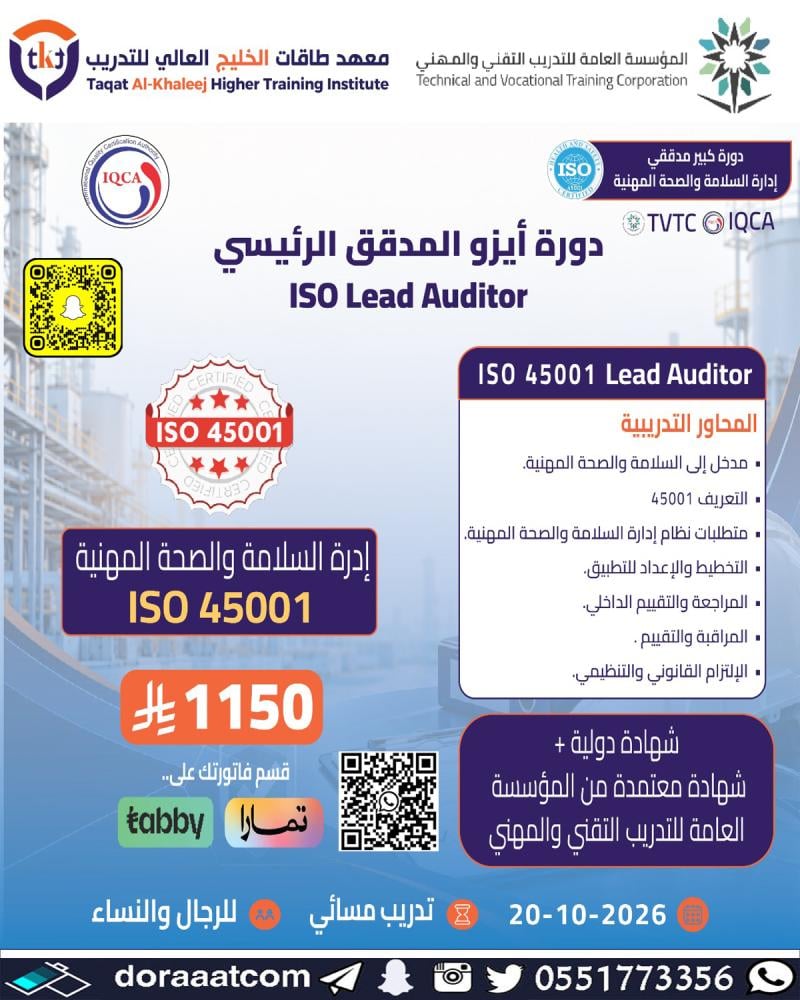
Online | ISO Lead Auditor Course (Chief Auditors) 45001
1150ر.س
Product description
The course begins on Tuesday, June 23, 2026.
What is ISO 54001?
ISO 45001 is an international standard for Occupational Health and Safety Management System (OH&S), issued by the International Organization for Standardization (ISO).
This standard aims to improve employee safety, reduce risks in the work environment, and provide safer and healthier working conditions.
Benefits of implementing ISO 45001:
✅ Reduce accidents and occupational injuries
✅ Improve employee satisfaction and increase productivity
✅ Reduce costs associated with accidents and insurance
✅ Compliance with legal and regulatory requirements
✅ Enhance the company's reputation and increase customer and partner trust
ISO 45001 replaces the previous standard OHSAS 18001, and organizations that relied on OHSAS 18001 can upgrade to ISO 45001.
Importance of ISO 54001?
Key features of ISO 45001:
1. Proactive approach: focuses on identifying and assessing health and occupational risks before accidents occur.
2. Continuous improvement: helps organizations develop a safer work environment through ongoing enhancement.
3. Integration with other standards: can be easily integrated with standards like ISO 9001 (Quality Management) and ISO 14001 (Environmental Management).
4. Promoting employee participation: encourages employees to participate in decision-making processes related to occupational safety and health.
Benefits of obtaining ISO 45001 certification?
ISO 45001 certification is not just a document, but a strategic investment that helps organizations provide a safe work environment, reduce risks, improve performance, and enhance their reputation in the market.
Would you like to know how to implement ISO 45001?
Write two examples of occupational health and safety management opportunities:
1. Introducing remote work systems to reduce occupational risks
🔹 Opportunity: reduce employees' exposure to risks by adopting remote work for some administrative tasks.
🔹 How to benefit from it?
• Reduce the number of workers in hazardous environments such as factories or construction sites.
• Decrease injuries related to commuting, such as traffic accidents when going to and from work.
• Use virtual meetings instead of field meetings in hazardous environments.
🔹 Result:
✔ Reduce exposure to occupational risks and traffic accidents.
✔ Improve work-life balance, reflecting positively on employees' mental health.
2. Using robots or automation in hazardous tasks
🔹 Opportunity: reduce risks to workers by automating dangerous processes using robots or smart machines.
🔹 How to benefit from it?
• Use robots in toxic environments like chemical factories.
• Replace manual work in high-altitude or high-temperature places with automated systems.
• Apply robotic arms in production lines to reduce injuries caused by muscular fatigue.
🔹 Result:
✔ Reduce accidents resulting from direct handling of risks.
✔ Improve production efficiency and reduce human errors.
Write at least 5 agenda items for the Board of Directors review:
Board Meeting Agenda – Discussing Opportunities for Occupational Health and Safety Management according to ISO 45001
Item No. | Topic | Details | Responsible Person | Estimated Duration
1️⃣ | Introduction to ISO 45001 and its importance | Review of ISO 45001 objectives and standards, and its role in improving the work environment. | Occupational Health and Safety Manager
2️⃣ | Analysis of the current safety and health situation in the organization | Present a report on accident rates, injuries, and potential risks. | Risk Management Manager
3️⃣ | Discuss opportunities to improve occupational safety and health | Review available opportunities to enhance the work environment, such as technology, training, and environment improvement. | Operations Manager
4️⃣ | Example 1: Applying smart technology to monitor risks | Discuss the possibility of using sensors and AI to improve the work environment. | IT Manager
5️⃣ | Example 2: Promoting safety culture among employees | Strategies to increase employee awareness of reporting risks and improving the work environment. | HR Manager
6️⃣ | Example 3: Developing emergency procedures and rapid response | Review and improve emergency plans according to best practices. | Security and Safety Officer
How does ISO 45001 address performance evaluation?
1. Defining performance indicators
• The standard requires organizations to identify key performance indicators (KPIs) that reflect the efficiency of the occupational safety and health system, such as accident and injury rates, near-miss reports, internal audit results, and compliance with legal requirements.
2. Monitoring and measurement
• The organization must implement continuous monitoring processes to collect data related to performance indicators.
• This includes using various measurement methods (quantitative and qualitative) to determine the effectiveness of procedures and measures taken.
3. Analysis and evaluation
• The collected data is analyzed to assess the achievement of the set goals for the occupational safety and health management system.
• This analysis helps identify strengths and weaknesses in the system, as well as opportunities for improvement.
4. Management review
• Senior management is required to conduct periodic reviews of the system based on performance evaluation results.
• These reviews are used to update policies and objectives and to take corrective actions to ensure continuous improvement.
5. Performance improvement
• The standard relies on utilizing performance evaluation results to identify areas for improvement and implement corrective and preventive actions to reduce risks and promote a safer work environment.
In this way, ISO 45001 ensures that performance evaluation is an integral part of occupational safety and health management, leading to an integrated system that helps achieve a safer and more effective work environment.
How does ISO 45001 handle subcontractors and external sources regarding occupational health and safety?
ISO 45001 aims to ensure that all activities related to occupational health and safety, whether internal or external (such as subcontractor activities), are integrated into an overall system.
This is achieved through:
• Selecting and evaluating contractors based on safety standards.
• Defining clear responsibilities within contracts.
• Establishing continuous communication and coordination mechanisms.
• Providing joint training and awareness programs.
• Conducting periodic monitoring and evaluation of contractors’ performance.
• Integrating contractors’ performance into the organization’s overall occupational health and safety management system.
