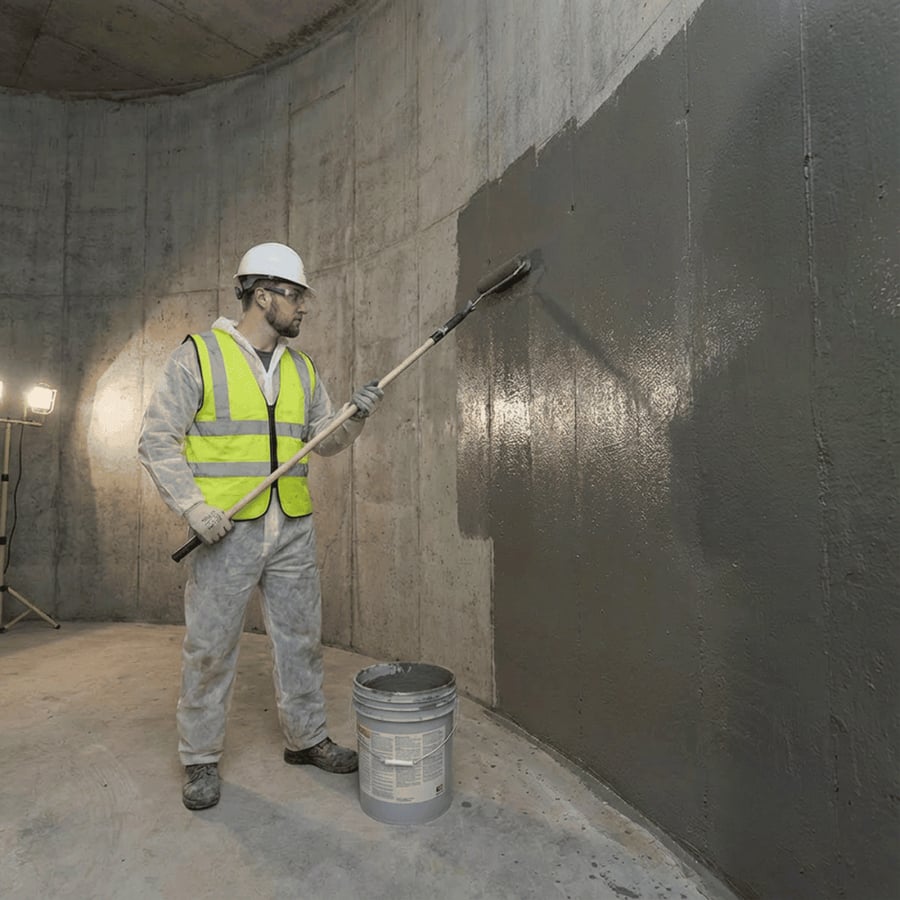
Tank insulation - Approved tank insulation company
45ر.س
Product description
What is a water tank insulation company in Riyadh? A water tank insulation company in Riyadh is a company specialized in protecting drinking water tanks from leakage and contamination through the application of approved engineering insulation systems, including: water-based epoxy (Epoxy) compliant with NSF/ANSI 61 and ASTM D4541 testing, polymer-modified cement (Polymer-Modified Cement) compatible with SASO 1575, and polyurea (Polyurea) according to ASTM C1583, BS 8102, and EN 1504 standards. The services cover complete technical inspection, repair of cracks including those caused by Legionella bacteria and Hexavalent Chromium corrosion, then application, testing, and delivery with a written warranty of up to 10 years.
Why is tank insulation a necessity that cannot be delayed in Riyadh? When you notice unexplained humidity near your home’s tank, or feel a change in the taste or smell of the water, know that these are signals requiring immediate intervention. Uninsulated water tanks pose a direct risk to the health of building occupants, and lead to accumulated financial losses due to water wastage and deterioration of infrastructure.
In the crowded Riyadh market, many homeowners and facility managers find it difficult to distinguish between a water tank insulation company in Riyadh with real experience and one relying on temporary solutions. The difference lies in three aspects: health-approved materials, reliable technical efficiency, and written guarantees that protect your long-term investment.
At Ibdā‘ Al-‘Imārān, as an authorized distributor of Sika insulation products (Sika) from Switzerland in the Kingdom, we offer water tank insulation solutions in Riyadh using epoxy, cementitious polymer, and polyurea materials that meet SASO specifications and Saudi Ministry of Health requirements, as well as comply with WHO Drinking Water Guidelines and AWWA standards for water storage systems.
Climate challenges and their impact on infrastructure The environmental conditions in Riyadh are quite different from other cities. Summer temperatures reach 45-48 degrees Celsius, with daily temperature differences exceeding 20 degrees between night and day. This repeated fluctuation gradually and silently stresses the concrete. Additionally, some areas' soil contains high levels of sulfates and soluble salts, which accelerate the deterioration of uninsulated tanks.
Repeated thermal stress produces three main effects on uninsulated concrete tanks:
- First, expansion and contraction of concrete, as large temperature differences create micro-cracks up to 0.2-0.4 mm wide.
- Second, accelerated chemical corrosion, where salts in the soil and groundwater react with the concrete, causing efflorescence and gradual structural weakening.
- Third, internal biological growth, where high temperatures combined with humidity promote algae and bacteria growth inside the upper tanks.
In other words, tank insulation here is not an optional precautionary measure but an essential engineering step dictated by the environment itself.
Health and economic risks of an uninsulated tank An uninsulated water tank opens the door to two scientifically documented problems that cannot be ignored:
On the health level: Drinking water becomes contaminated with chemicals from the concrete, such as Hexavalent Chromium, and Legionella bacteria grow in tanks with temperatures between 20-50 degrees Celsius, in addition to external pollutants leaking through cracks. WHO Drinking Water Guidelines indicate that uninsulated or unclean tanks can become environments for pathogenic bacteria if not insulated and maintained according to health standards.
On the economic level: Leaks waste between 15-30% of the tank’s capacity monthly, and water bills increase by 40-60% in severe cases, along with recurring maintenance costs for temporary repairs and damage to finishes and ceilings due to infiltrated humidity.
Types of tank insulation materials: Your technical guide Choosing the appropriate insulation material is not solely based on price. The right type is determined by the tank’s nature, size, usage, and structural condition. Below is a detailed overview of the most commonly used systems.
1 - Water-Based Epoxy Insulation Water-based epoxy is the ideal choice for underground and overhead concrete drinking water tanks, small residential and commercial facilities, as well as repairing old tanks with minor cracks. Its adhesion to concrete exceeds 2.5 MPa according to ASTM D4541, and it withstands continuous hydrostatic pressure up to 5 bar. The recommended thickness is two coats at 300-500 microns each, with 6-12 hours drying time between coats. Its smooth surface reduces sediment and microbial buildup, fills cracks up to 0.5 mm wide, with a lifespan of 10-15 years. Approximate cost: 15-25 SAR/m².
2 - Polymer-Modified Cement Suitable excellently for new tanks during construction, for tanks requiring structural reinforcement, and for negative side waterproofing. Its compressive strength reaches 25-30 MPa after 28 days, with water permeability less than 0.1 kg/m²/hour under 1.5 bar pressure. It features flexibility to tolerate slight movements up to 0.3 mm and is easily applied with a brush or trowel on relatively moist surfaces, with excellent resistance to salts and sulfates. Approximate cost: 12-20 SAR/m².
3 - Polyurea Spray The preferred choice for large commercial tanks exceeding 100 m³, projects requiring rapid execution, and industrial water treatment tanks. It dries in 10-30 seconds, with a Shore A hardness index between 85-95, and elongation at break over 400%. It forms a continuous, seamless protective membrane, operates within pH range 2 to 12, with a lifespan of 20-25 years. It requires professional spraying equipment and is relatively more expensive, costing between 65-95 SAR/m².
4 - Foam Thermal Insulation (Polyurethane Foam) Used exclusively for external insulation of overhead tanks exposed to sunlight. Its thermal conductivity ranges from 0.022-0.028 W/m.K, with a density of 35-40 kg/m³, and recommended thickness of 50-80 mm. It reduces water temperature by 8-12 degrees Celsius in summer, is lightweight, adding no load to the surface, and has a lifespan of 15-20 years. Approximate cost: 35-55 SAR/m².
Comparison of tank insulation systems
In terms of safety for drinking water: Water-based epoxy and polymer-modified cement achieve excellent and approved direct contact ratings, while polyurea is rated good, and thermal foam is used externally only and does not contact water.
In terms of speed of implementation: Polyurea is the fastest due to its quick drying within seconds, followed by epoxy and foam at 24 hours, then polymer-modified cement which takes 48 hours.
In terms of lifespan: Polyurea leads with 20-25 years, followed by thermal foam with 15-20 years, then epoxy with 10-15 years, and finally polymer-modified cement with 8-12 years.
In terms of crack resistance: Epoxy excels in filling cracks up to 0.5 mm, and polyurea for cracks exceeding 2 mm, while polymer-modified cement has moderate capacity, and foam is weak in this area.
In terms of ease of maintenance: Epoxy and polymer-modified cement are easier to maintain, while polyurea requires specialized equipment for repairs.
In terms of cost: Polymer-modified cement is the most economical at 12-20 SAR/m², then epoxy at 15-25 SAR/m², followed by foam at 35-55 SAR/m², and polyurea is the most expensive at 65-95 SAR/m².
To explore complementary insulation services: Riyadh roof insulation, water leak detection in Riyadh, bathroom insulation in Riyadh, foundation and footing insulation, concrete repair in Riyadh.
Comprehensive water tank insulation services in Riyadh Good insulation does not start with applying a layer on the walls but begins earlier with a precise inspection stage that ensures the correct solution for the right tank.
First stage: Inspection and diagnosis Includes measuring tank dimensions, documenting cracks and fractures, inspecting reinforcement condition, and evaluating drainage and overflow systems. Technically, leak tests are conducted for 24 hours, concrete permeability testing according to ASTM C642, surface moisture measurement according to ASTM D4263, and water pH testing to detect chemical reactions. The stage ends with a technical report recommending the suitable insulation type, a list of required repairs, and a timeline for implementation.
Second stage: Preparing the tank and initial repairs The quality of preparation determines the lifespan of the insulation, so this stage is as important as the application stage. The tank is fully drained, sediments are mechanically removed, then it is pressure-washed up to 150 bar, disinfected with a chlorine solution at 50 ppm, and dried with industrial fans. Crack treatment varies according to width: cracks less than 0.5 mm are treated with low-viscosity epoxy injection, cracks between 0.5-2 mm are widened and filled with epoxy putty, and cracks wider than 2 mm are repaired with Repair Mortar materials.
Third stage: Applying the insulation system The application begins with a primer layer that increases adhesion by up to 60%, consuming 0.2-0.3 kg/m². Followed by the first coat with roller or spray at 50% of the final system thickness, then the second coat perpendicular to the first with reinforcement in critical areas. The stage concludes with a chemical protective layer and sealing joints with approved silicone.
Fourth stage: Testing and delivery The work is not considered complete until passing the hydrostatic pressure test for 48 hours, the adhesion pull-off test, and measuring thickness with a Dry Film Gauge. Delivery includes a detailed quality report, a technical completion certificate, and a written warranty of 10 years.
Insulation of tanks according to type and application
Underground concrete tanks (nominal capacity 5-50 m³, depth 2-4 meters): internally coated with water epoxy at 400 microns, externally insulated with polymer cement and HDPE geomembrane.
Overhead tanks (plastic or fiberglass): thermal insulation with 50 mm polyurethane foam externally, heat-resistant epoxy internally.
Commercial and industrial tanks (hotels, hospitals, factories, capacity over 500 m³): subject to stricter requirements due to the potential impact size. They require compliance with NSF/ANSI 61, WRAS standards, and AWWA recommendations, with a full polyurea system and preventive maintenance program.
Approvals and standards
Saudi standards: SASO 1575, SASO 41-2/1996, Saudi Building Code (SBC), local municipality requirements in Riyadh, Saudi Ministry of Health guidelines for drinking water tanks.
International approvals: NSF/ANSI 61 for contact with drinking water, ASTM C1583 for layer tensile testing, BS 8102 for water-proofing, EN 1504 for concrete repair products, WHO Drinking Water Guidelines, and AWWA standards for water storage.
All Sika products used are 100% genuine, stored at 15-25°C, and accompanied by certified technical Data Sheets from the parent company.
New tanks vs. renovation of old tanks The best time to insulate new tanks is after 21-28 days of concrete pouring, when they have gained sufficient structural strength without micro-cracks appearing. Early intervention saves effort and money in the long run, costing 18-30 SAR/m².
Renovating old tanks involves removing damaged concrete, treating the steel reinforcement, and rebuilding eroded areas, at a cost of 25-45 SAR/m². However, in some cases, replacement is the more economical decision: when corrosion exceeds 40% of the surface area, steel corrosion reaches 30%, or the tank’s age exceeds 25 years.
Price estimate table based on size and material type
For a 10 m² tank with a capacity of 20-25 m²: epoxy 400-600 SAR, polymer cement 350-500 SAR.
For a 20 m³ tank with a capacity of 40-50 m²: epoxy 800-1,250 SAR, polymer cement 700-1,000 SAR, polyurea 3,000-4,500 SAR.
For a 40 m³ tank with a capacity of 70-80 m²: epoxy 1,400-2,000 SAR, polymer cement 1,200-1,700 SAR, polyurea 5,000-7,000 SAR.
For a 100 m³ tank with a capacity of 150-180 m²: epoxy 3,000-4,500 SAR, polymer cement 2,600-3,800 SAR, polyurea 9,000-14,000 SAR.
Frequently Asked Questions
What is the cost of insulating an underground tank in Riyadh? The cost of insulating underground tanks in Riyadh ranges between 15 and 25 SAR per square meter when using NSF/ANSI 61 approved water-based epoxy, and between 12 and 20 SAR/m² for polymer cement, reaching up to 65-95 SAR/m² when using polyurea for large commercial projects. The final cost varies according to the tank’s size, structural condition, and required repairs before application.
Is tank insulation mandatory by the municipality? According to the Saudi Building Code (SBC) and local municipality requirements, drinking water tanks must be protected with non-toxic, leak-resistant materials. Therefore, municipalities recommend an approved health insulation system that complies with SASO 1575 specifications and Saudi Ministry of Health standards to ensure water safety and prevent contamination from chemicals in the concrete.
What is the best material for drinking water tank insulation? The approved water-based epoxy according to NSF/ANSI 61 is the most widely used for drinking water tanks, with adhesion strength exceeding 2.5 MPa according to ASTM D4541, and its smooth surface reduces sediment and microbial buildup. For tanks over 100 m³, polyurea is preferred for its lifespan of 20-25 years and ability to cover continuous surfaces without joints.
How often should tanks be maintained or re-insulated? AWWA and Saudi Ministry of Health guidelines recommend inspecting tanks every 2-3 years at minimum, with regular cleaning every 6-12 months. The lifespan of good insulation systems ranges from 10 to 25 years depending on the material used and operating conditions. Any signs of cracks or changes in water taste or smell require immediate inspection without waiting for scheduled cycles.
How do I know if my tank needs removal of old insulation and re-application? Three main signs require removing old insulation and reapplying: peeling of the insulation layer from more than 20% of the surface, cracks wider than 2 mm in the insulating layer, or failure of the adhesion test (Adhesion Pull-Off Test) to give readings above 1.5 MPa. If the current insulation exceeds 15 years and has not undergone regular maintenance, removal and reapplication are more economical than patching.
Why is Ibdā‘ Al-‘Imārān the best choice for insulating your tanks in Riyadh? With over 12 years of experience in insulation work, more than 2,500 projects completed in Riyadh, and a technical team completing approximately 300 tanks annually in various residential and commercial projects, these figures are accumulated project after project, not just marketing slogans.
Ibdā‘ Al-‘Imārān, as an authorized distributor of Sika insulation products, relies on 100% genuine products supported by technical support from the company’s engineers. A written 10-year warranty covers leak prevention, layer stability, and water quality preservation.
Geographical coverage in Riyadh: North Riyadh (Al Narges, Al Sahafa, Al Malqa, Al ‘Uyaynah), East Riyadh (Al Rawdah, Al Nasaim, Al Riyan), South Riyadh (Al Shifa, Shubra, Manfuhah), West Riyadh (Al Swaidi, Al Rabwa, Al ‘Areijjah).
Protect your investment with a free engineering inspection within 24 hours
The water tank accounts for about 15-20% of the building’s infrastructure system and is the primary source of daily drinking water. Untreated tank leaks cost thousands of riyals annually and cause structural damages affecting the entire building.
With Ibdā‘ Al-‘Imārān for Sika insulation products, you get: a free engineering inspection within 24 hours, a clear technical report before implementation, professional execution using original Sika materials, and a written 10-year warranty.

From Medina
Questions you might have