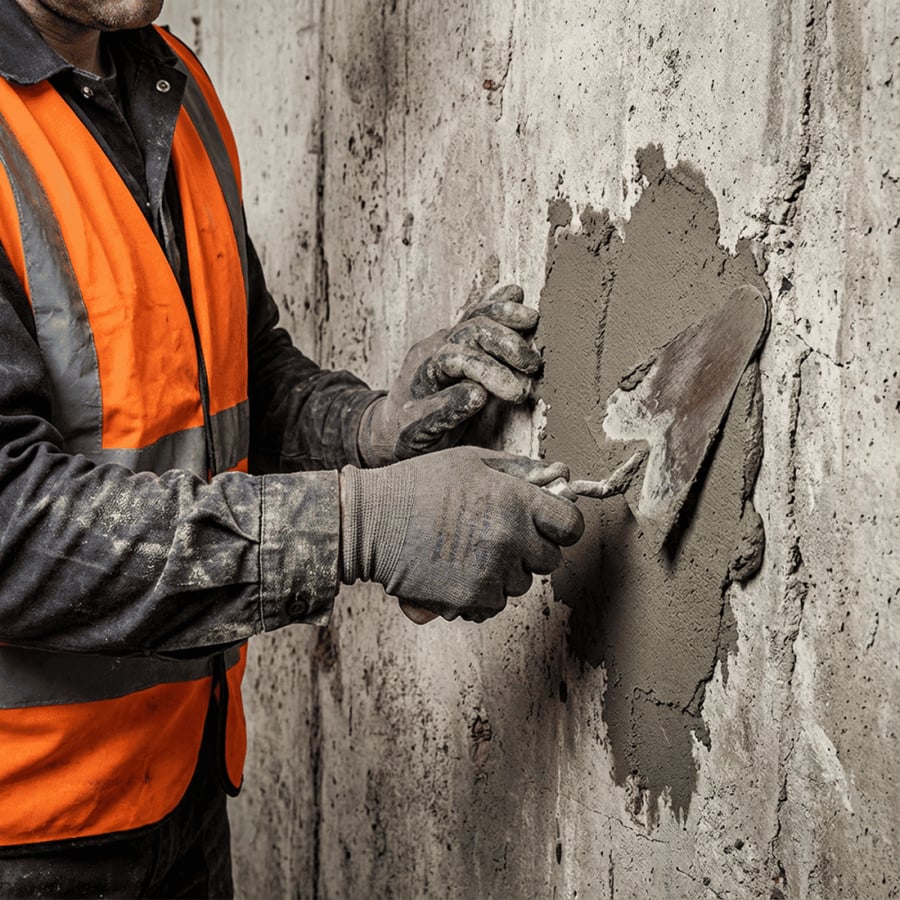
Concrete crack treatment materials with Sika products
8ر.س
Product description
An one of project managers of construction projects in Riyadh faced a critical situation: after removing the formwork of one of the concrete columns in a commercial project, clear gaps appeared revealing reinforcement bars. The immediate question: is this column structurally safe? And what is the correct technical and economical solution? Honeycomb concrete is not just a cosmetic defect that can be ignored, but a direct indicator of potential weakness in the structural integrity. In the Saudi market, where projects vary between large residential, commercial, and industrial, treating honeycomb concrete with approved materials has become an engineering necessity to ensure safety and long service life of the structures. This technical guide is directed to contractors, civil engineers, and project managers seeking accurate information about honeycomb treatment materials in concrete, correct selection standards, approved application steps, and the fundamental differences between systems available in the Saudi market. What is honeycomb concrete and why does it occur? Honeycomb concrete is the appearance of voids or large pores inside the cast concrete element, resulting from non-uniform distribution of the concrete mix during pouring. These voids weaken the bond between cement, aggregate, and reinforcement, creating structural weak points that may develop into cracks or structural failure. Common implementation causes during pouring: Absence or weak compaction: improper or insufficient use of mechanical vibrator Pouring from great heights: leads to segregation of mix components Rapid pouring: without giving concrete time to settle in formwork Mix design: inappropriate water/cement ratio: too dry or too liquid Aggregate size not suitable for the section: using large aggregate in thin sections Design factors: High reinforcement density: without leaving enough space for concrete to pass Wooden formwork not tight: allows slurry leakage Complex or narrow sections: difficulty in reaching all corners Effects on structural performance: Reduced compressive strength: up to 40% in severe cases Exposure of reinforcement to corrosion: when exposed or near surface Water and moisture leakage: especially in foundations and tanks Bond weakening between concrete and steel: affects load transfer capacity Permissible honeycomb ratio in concrete There is no unified global standard that specifies a "permissible ratio" for honeycomb, because acceptance depends on: Location of honeycomb: column, beam, slab, foundation Depth of voids: superficial, medium, or deep Effect on reinforcement: exposed or protected Origin: residential, commercial, industrial, tanks Classification of honeycomb degrees 1 - Simple surface honeycomb: depth less than 10-15 mm does not expose reinforcement decision: cosmetic treatment using repair mortar 2 - Medium honeycomb: depth 15-30 mm partially exposes reinforcement decision: structural treatment using grout 3 - Deep/serious honeycomb: depth more than 30 mm fully exposes reinforcement large voids affecting the cross-section decision: specialized epoxy treatment or structural re-evaluation When should the concrete element be rejected? In some critical cases, treatment is insufficient: Honeycomb covering more than 20% of the cross-sectional area Main columns or beams with widespread deep honeycomb Sensitive structural elements: like foundations under heavy equipment The solution: may require demolition and re-pouring. Types of honeycomb treatment materials in concrete 1. Grout (Cementitious Grout) A cementitious material modified with polymers, highly flowable, with low shrinkage, designed to fill voids and restore concrete density. Composition: High-strength Portland cement Fine graded aggregate Polymer additives to improve adhesion Shrinkage-compensated additives Ideal uses: Filling deep voids in columns and walls Repairing structural honeycomb needing high compressive strength Foundations and base repairs Projects requiring resistance to heavy loads Technical specifications (example from Sika products): Compressive strength after 28 days: 40-60 MPa Working time: 30-45 minutes Application thickness: 10-100 mm Advantages: Compressive strength comparable to or exceeding the original concrete Zero shrinkage or slight expansion Good weather resistance Reasonable cost compared to epoxy Limitations: Requires precise mixing and limited working time Bond strength less than epoxy Not suitable for very narrow voids 2. Epoxy Resin Systems Definition: A two-component industrial resin (Resin + Hardener) characterized by exceptional adhesion and superior chemical resistance. Composition: Part A: Epoxy resin Part B: Hardener Filler may be added to increase volume and reduce cost Critical uses: Repairing deep honeycomb exposing reinforcement elements subjected to dynamic loads like under equipment, areas exposed to chemicals or continuous water injection into cracks. Technical specifications: Tensile strength: 25-40 MPa Adhesion strength: over 10 MPa Application temperature: 10-35°C Advantages: Highest adhesion among all materials Excellent water and chemical resistance No maintenance required Can be applied in very thin layers Limitations: Higher cost (2-3 times grout) Sensitive to application conditions (humidity, temperature) Requires precise mixing ratios Longer curing time to reach full strength 3. Bonding Agents (Bonding Primers) Definition: A bonding layer (Primer) applied to the old concrete surface before pouring or applying new repair materials. Types: Cementitious polymer-based bond: like Sika®Bond T-55 Epoxy bond: for critical cases Acrylic bond: for surface repairs Function: Ensures complete adhesion between old concrete and repair materials Prevents delamination after repair Improves penetration of repair materials into pores Application method: Brush or spray primer on prepared surface Wait until tacky (according to product instructions) Apply grout or repair mortar immediately 4. Repair Mortars (Repair Mortars) Definition: Ready-made polymer-modified mixes used for surface repairs and final finishing. Uses: Surface honeycomb (less than 10 mm) Final finish after filling voids with grout Repairing broken edges and corners Advantages: Easy to apply without special equipment Good adhesion to concrete Smooth finish easy to paint Comparison between grout and epoxy Grout is best suited for deep voids and load-bearing, while epoxy is the preferred choice for critical structural repairs. In terms of compressive strength, grout ranges between 40–60 MPa, while epoxy offers higher strength between 70–90 MPa. For adhesion, grout ranges from 2–4 MPa, while epoxy reaches 10–15 MPa. Water resistance: grout offers good resistance, epoxy excellent. Chemical resistance: limited in grout, very high in epoxy. Shrinkage: grout is zero or slight expansion, epoxy has slight shrinkage. Ease of application: moderate for grout, higher technical skill needed for epoxy. Cost (SAR/m³): grout between 800–1500 SAR, epoxy between 3000–5000 SAR. Curing time: grout 24–48 hours, epoxy 3–7 days. Service life: grout 20–30 years, epoxy 30–50 years. When to choose grout? Honeycomb in elements subjected to vertical load pressures (columns, walls) Large areas needing filling Budget limited Ordinary residential and commercial projects When to choose epoxy? Honeycomb exposing reinforcement fully Elements exposed to vibrations or dynamic loads Areas exposed to continuous water or chemicals Critical industrial or infrastructure projects Steps for professional concrete honeycomb treatment Phase 1: Inspection and assessment Visual inspection includes: identifying and documenting honeycomb locations (photos, drawings) measuring void dimensions (depth, width, length) inspecting reinforcement condition (rust, corrosion) sounding: using hammer to detect weak surrounding concrete identifying hollow-sounding areas Laboratory tests (in critical cases): Ultrasonic pulse velocity (UPV): to assess concrete homogeneity Schmidt hammer test: to estimate surface resistance Core sampling: for compressive testing Phase 2: Cleaning and preparation Removing weak concrete: using electric chisel or high-pressure water jet Deepening the area 10-20 mm behind reinforcement Creating beveled edges for better adhesion Cleaning reinforcement: removing rust with wire brush or sandblasting applying rust inhibitor (like Sika® Armatec) ensuring surface cleanliness from dust and oils Preparing the concrete surface: pressure washing, removing dust with compressed air or vacuum moistening the surface without saturation (Saturated Surface Dry - SSD) Phase 3: Selecting and applying treatment material Treatment with grout 1. Applying primer: coating the surface with a layer of cementitious bond Wait according to product instructions (15-30 minutes) 2. Mixing grout: following precise water/powder ratio mixing with an electric mixer for 3-5 minutes obtaining a flowable consistency without bubbles 3. Pouring and vibrating: pouring grout in layers no more than 50 mm using a tamping rod or light vibration ensuring all voids are filled 4. Finishing: leveling the surface with a trowel Wet curing for 7 days Treatment with epoxy 1 - Ensuring surface dryness: epoxy does not tolerate moisture using a heat dryer or waiting 2 - Mixing components: mixing part A and part B in specified ratio thorough mixing for 2-3 minutes using the mixture within the working time (30 minutes) 3 - Application: applying a thin layer first filling voids with epoxy mixed with filler removing bubbles with needle or air 4 - Curing: waiting 24 hours before final finishing avoiding water exposure for 3 days Phase 4: Final inspection and warranty Visual inspection: ensuring no voids or bubbles adhesion test: confirming no hollow sound documentation: taking before and after photos preparing a technical report on materials used and quantities Concrete honeycomb prevention: contractor’s guide During design phase: coordinate with consulting office on reinforcement density review element sections: avoid complex sections if possible choose appropriate aggregate size: not exceeding one-third of the smallest distance between rebars During pouring: prepare mix: use pumpable mix for long columns add superplasticizers to improve flow without increasing water During pouring: pour in uniform layers 300-500 mm use mechanical vibrator for 5-10 seconds at each point avoid pouring from heights over 1.5 meters use a funnel or guiding tube in narrow columns Wooden formwork: ensure formwork is tight to prevent slurry leakage clean formwork before pouring from previous concrete use release oil without excess follow-up after pouring: inspect elements immediately after formwork removal regular moist curing to prevent cracks immediate documentation of any visible defects Why choose Ebraa Al-Omran for honeycomb treatment? Ebraa Al-Omran is the authorized distributor of Sika products in Saudi Arabia, providing comprehensive honeycomb treatment solutions: 1. Genuine approved products: Sika® Grout Series: Swiss specifications grout Sikadur® Epoxy Systems: high-performance epoxy systems Sika®Bond Range: specialized bonding materials Certifications: SASO, ISO, factory certificates 2. Specialized technical support: engineering consultations to assess the condition selecting suitable material based on honeycomb type preparing BOQ (Bill of Quantities) training site teams 3. Reliable supply: continuous stock of all products quick delivery to Riyadh and regional sites competitive prices for large projects quality assurance on all products 4. Local expertise: deep understanding of Saudi project characteristics knowledge of local climate and challenges documented record in residential, commercial, and industrial projects Cost estimate for honeycomb treatment in 2026 Factors affecting cost 1. Material type: cement grout: lowest cost epoxy: highest cost 2. Honeycomb size: depth and affected area number of damaged sites 3. Location of honeycomb: columns or beams: may need special equipment foundations: may require excavation 4. Labor costs: ranging between 150-300 SAR/m² depending on difficulty Approximate price range (Saudi Arabia 2026) Sika products (without installation): Sika® Grout: 35-55 SAR/kg (25 kg bag) Sikadur® Epoxy: 150-250 SAR/kg (two-component pack) Sika®Bond: 40-70 SAR/liter Repair mortar: 25-40 SAR/kg Overall estimate (materials + labor) per square meter: Surface honeycomb (<10 mm): 120-180 SAR/m² Medium honeycomb (10-30 mm): 250-400 SAR/m² Deep honeycomb (>30 mm): 500-800 SAR/m² Note: Prices are approximate and depend on actual site inspection and work volume assessment. Frequently Asked Questions about concrete honeycomb treatment 1 - Can honeycomb be left untreated if superficial? Not recommended. Even superficial honeycomb opens the door for water and moisture infiltration, gradually leading to reinforcement corrosion. Early treatment is much less costly than later repairs. 2 - How long does it take to treat a medium-sized concrete column? For medium honeycomb in one column: one day for preparation and cleaning, one day for application, and 3-7 days for curing before resuming work, totaling 5-9 days. 3 - Does grout treatment fully restore the original concrete strength? Yes, if executed properly. Modern grouts are designed to achieve or surpass the surrounding concrete’s resistance, but technical instructions must be followed precisely. 4 - When should a structural engineer be consulted regarding honeycomb? Immediately in cases such as: honeycomb covering more than 15% of the element’s cross-section, main columns or beams with widespread deep honeycomb, sensitive structural elements like foundations under heavy equipment, or uncertainty about the structural integrity. 5 - Is there a warranty period for treatment works? When executed with genuine Sika products under certified supervision, a warranty of 5-10 years can be provided against material separation or recurrence of the problem, provided regular maintenance is performed. Honeycomb concrete is not the end of the road, but a manageable problem with high effectiveness when using proper materials and approved engineering methods. The difference between successful and failed repairs lies in: accurate assessment of honeycomb degree, choosing the right material (grout or epoxy), quality of execution and adherence to steps. With Ebraa Al-Omran, you get the complete solution: genuine Sika products, technical expertise, and field support to ensure long-term results that meet engineering and regulatory standards in the Kingdom. Facing honeycomb issues in your current project? Or want a technical consultation on the best treatment materials for a specific case? Do not hesitate to contact us — our team is ready to provide approved solutions that ensure your project’s safety and long service life.

From Medina
Questions you might have