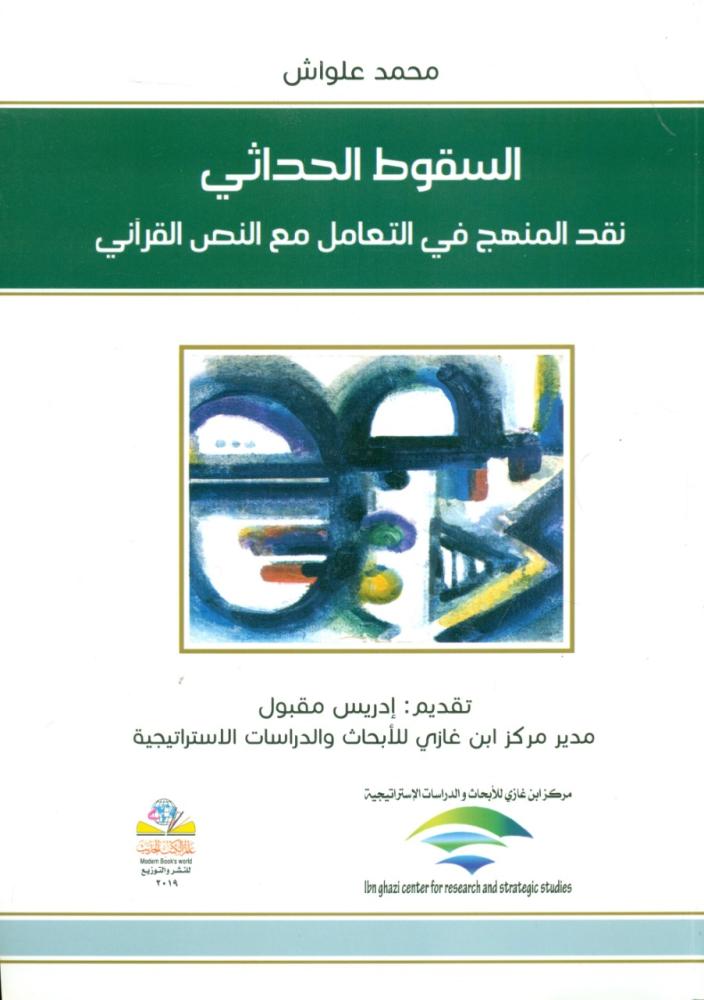
Modernist fall critique of the approach in dealing with the Quranic text
63.25ر.س
Product description
Since the revelation of the text of the revelation, dealing with it has been surrounded by a strong awareness among the Companions, may Allah be pleased with them, regarding its specificity and transcendence. Despite its descent in clear Arabic language and in accordance with the Arab customs in speech, understanding the intention of the speaker, which is the basis of comprehension, remained a sign of caution and vigilance. This led many scholars to speak about the intention of the speech rather than the intention of the speaker, and it prompted others throughout the ages to be cautious about studying Tafsir (interpretation) entirely and in detail, following the doctrine of Abu Bakr, may Allah be pleased with him, who said: "Any land that carries me and any sky that shades me if I say in the Book of Allah what I do not know."
However, this doctrine, despite its fame, did not prevent the misinterpretation of the Holy Quran with corrupt interpretations that twist the texts to serve sectarian, political, social, economic, and other interests, which is part of what we call the plague of "Taqwīl" (interpretative distortion).
Taqwīl is a form of misinterpretation, and "Taqwīl" and "Taqwīl" are specific interpretive lies, a form of fabrication. To attribute to someone that he said something he did not say is what is meant by Taqwīl about that person or Taqwīl of someone else, meaning to say that he said something he did not.
This book, which we present today under the name of Ibn Gazi Center for Research and Strategic Studies, authored by Dr. Muhammad Alwaash, sheds light on the modernist approaches in their "Taqwīl" and "Tafsir" of the noble revelation text, aiming to strip it of its sacred dimension and treat it as they do with historical and human texts, without regard to its transcendence and exaltation.
In this book, the researcher addresses the issue of the slipping of modernist approaches and the fall of their proponents (Arkun, Amina Wadud, Nasser Hamid Abu Zaid) under the influence of personal motives and social and ideological ties that push toward attacking the text and loading it with tons of "concealed" desires and caravans of interpretive lusts, in order to create a state of illusory satisfaction and supposed fulfillment that "interpretation" has achieved the necessary degree of understanding and harmony with the "text" and the parts of the world around us. In truth, what these approaches offer is nothing but cognitive deception that exercises its power over the interpreter, just as a mirage exercises its power over the thirsty in luring him to the false water reservoir.
Ibn Ash-Shatibi, in his book "Al-Muwafaqat," contracted a chapter within his project to set boundaries for interpretation, confronting the Hermetic Batinist school in all its forms. He did not leave any door of this type of interpretation without warning in a strict scientific manner that is credited to him. He indicated that the flaw in the strategy of interpretation built by the interpreter is that any interpretation outside its context is "an attribution by the speaker," and since the Quran is the speech of Allah, he says in His language: "This is Allah's intended meaning from this speech." He urges that Allah, the Exalted, should be asked: "Where did you say about me this?" and that this is only valid with supporting evidence. He aims to put an end to any interpretation based on any possibility whatsoever, as long as the possibility is valid within the core of science. Otherwise, possibilities that do not refer back to an original are not credible. In any case, every definitive statement must be supported by evidence that testifies to its origin; otherwise, it is invalid, and its author falls under the banner of blameworthy opinion.
The tendency of the deliberate interpreter is to seek in the texts and sayings that he interprets the meanings that suit him and the contents that attract him. It is like someone standing in the sunlight but turning his back to it; he only looks at his shadow, and his shadow, upon closer inspection, is what he believes and trusts. And what he believes in as the sun in his mind is nothing but the origin of shadows.
The researcher Muhammad Alwaash has diligently monitored the points of failure in modernist approaches to treating the Quranic text. He has been largely successful in identifying the ideological backgrounds behind these approaches, and has also uncovered the deception practiced by these approaches when they mix "subjectivities" with "science" to the extent that desires and illusions turn into scientific results with loud media and academic noise.

From Jeddah