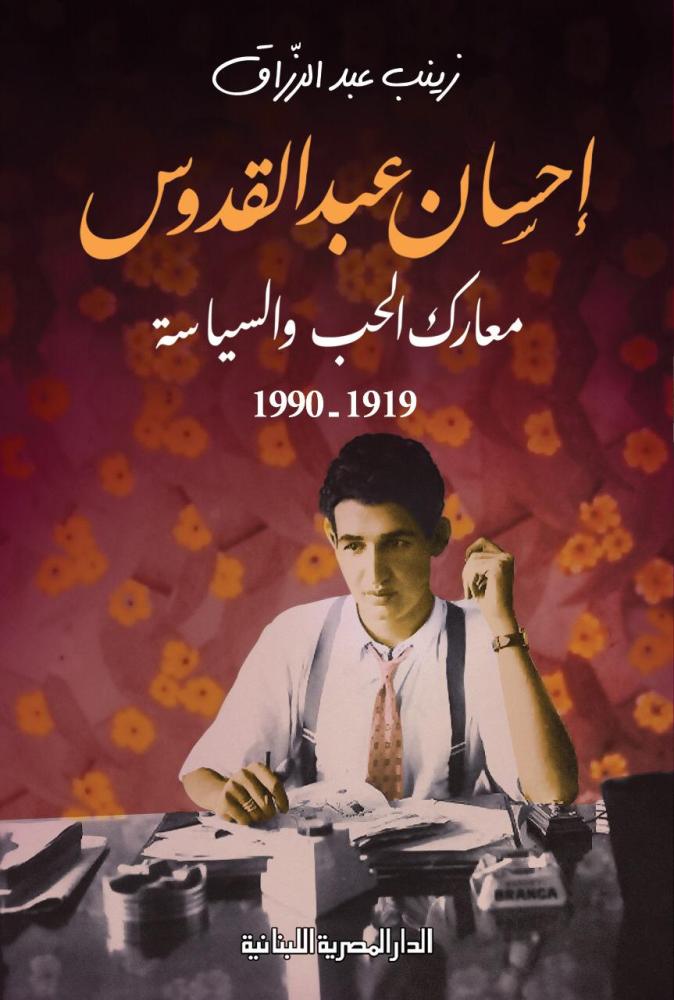
Ehsan Abdel Quddous, love and politics battles, 1919 - 1990
28.75ر.س
Product description
The book dives into the life story of Ehsan Abdel-Quddous through tracing several intersecting lines of his life; the first is his upbringing, the circumstances of his birth, his deprivation of his mother in childhood, and the reasons for this deprivation.
The second line is about his mother’s personality, who challenged the prevailing societal customs and traditions, and stood on the stage, then her decision to issue her famous magazine "Rose Al-Youssef," which contributed to shaping Ehsan’s conscience, who refused to continue in the legal profession due to the call of literature and politics.
The third line is his oscillation between different worlds; the world of his grandfather Sheikh Radwan, who adhered to the principles of religion, the world of his mother who worked in acting, and the world of his father who left his original profession to dedicate himself to writing plays.
The fourth line discusses Ehsan’s writings of articles that led to his imprisonment, while the fifth line is about his wife, Mrs. Lawhaaz Al-Muhailami, who supported him and stood by his side. The sixth line is his relationship with Presidents Gamal Abdel Nasser and Anwar Sadat.
The book contains 9 chapters, each discussing a different aspect of Ehsan Abdel-Quddous’s life, beginning with the contrasting worlds of his grandfather and mother.
The second chapter discusses the profound influences his mother, Mrs. Fatima Al-Youssef, instilled in him, and the author examines highly sensitive files in the relationship between Ehsan and Fatima Al-Youssef "Rose Al-Youssef," especially when she expelled him from the magazine, and she remained a whole year without speaking to him or acknowledging him in public, despite being a family man with children at that time.
It sheds light on the origins of Mrs. Fatima Al-Youssef, who was born in Tripoli, Lebanon, and her work with Georges Abyad and Youssef Wahbi, until she carried the title "The Middle East Sarah Bernhardt," after playing the role of "Marguerite Gauthier" in the play "Ghada Al-Kamiliya."
The third chapter is considered the most sensitive, as it contains fascinating details about the major journalistic criticism Ehsan Abdel-Quddous launched against palace practices, political police, and his attack on Lord "Kellern" in an article titled "This man must go," accusing him of acting as if he were the king of Egypt.
The book also narrates details of Ehsan’s imprisonment during the revolution, Nasser’s attempts to reconcile with him after detention, and Ehsan’s firm refusal to contact Sadat for intervention to release his son, who was detained during the September 1981 events.
There are 4 personal letters and documents published for the first time, including a letter to Taha Hussein, the Dean of Arab Literature, a letter to Ali Saqr, the former Vice President of Egypt, and two letters about the issue of rotten weapons that Ehsan Abdel-Quddous exposed, obtained by the author from Ehsan’s son, Engineer Ahmed Abdel-Quddous, which are included in the main text of the book.

From Jeddah