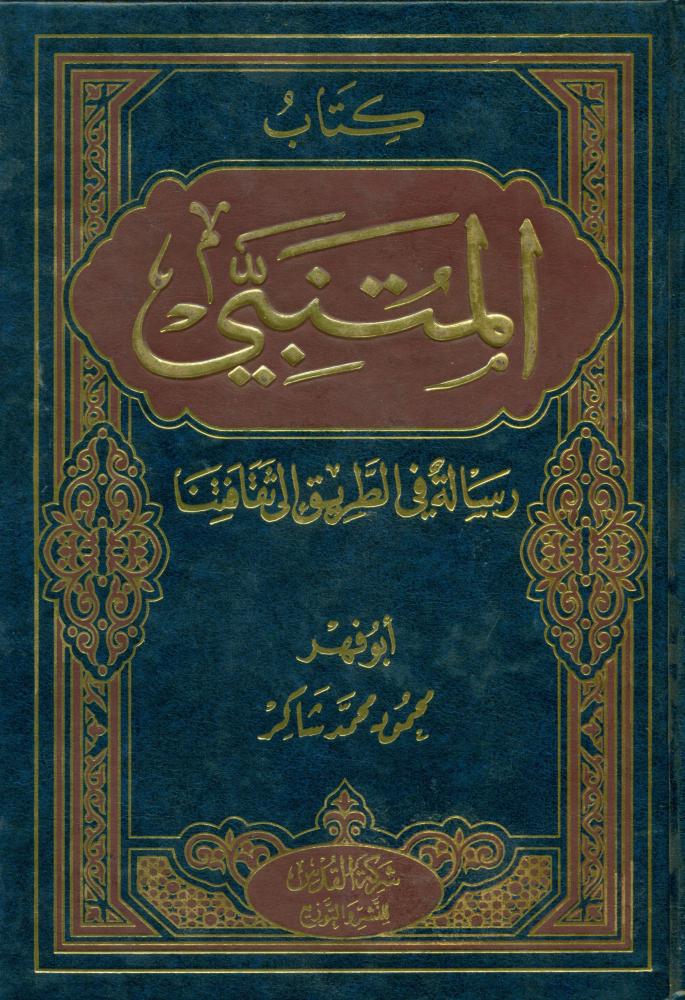
Al-Mutanabbi is a message on the way to our culture
57.50ر.س
Out of Stock
Product description
Professor Mahmoud Muhammad Shakir wrote the Mu'tazilah book in 1936 when he was 26 years old, at the request of Fuad Surour, editor-in-chief of Al-Muqtataf magazine. In truth, Professor Mahmoud Muhammad Shakir did not initially intend to author the book in the form we see now, but rather his aim was to write a study of about thirty-two pages as requested by the editor-in-chief of Al-Muqtataf, to be published on the anniversary of Al-Mutanabbi. But Allah made it easy for Professor Shakir, and the book was produced in a short period with a unique approach.
Al-Muqtataf published the book Al-Mutanabbi by Professor Mahmoud Muhammad Shakir (issue issued on the sixth of Shawwal 1354 AH, January 1, 1936). The editor-in-chief, Fuad Surour, stated: “This issue of Al-Muqtataf differs from every issue issued in the past two years until today, as it is on one topic and by one author.”
Know that I spent ten years of my youth, in bewilderment and intense misguidance, torn by doubts, until I feared for myself destruction, and losing my world and my hereafter, feeling shame for a sin that casts me into God's torment for what I have done. So, my only concern at that time was to seek a glimmer of light to guide me out of the grave of these all-encompassing darkness from every side.
From the time I was seventeen years old in 1926, until I reached twenty-seven in 1936, I was immersed in the depths of a literary life that I began to feel vaguely and increasingly that it was a corrupt life from every aspect.
I found no salvation except to reject, cautiously and carefully, more and more, all the literary, political, social, and religious approaches that at that time overwhelmed like a rushing flood, demolishing dams, and undermining everything that was within me and my innate nature.
And at that time, I folded my soul with a firm resolve to go ahead: to start, alone and solitary, a very long, very distant, very arduous, and very exciting journey. I began by re-reading all Arabic poetry, or what I had at hand at that time, with careful, deliberate reading at every word and meaning, as if I were turning them over in my mind, weighing them (i.e., testing them), with my heart, feeling them with my sight and intuition, as if I wanted to feel them with my hands, and inhale (i.e., smell) what emanates from them with my nose, and hear the faint heartbeat of life within them with my ears — then I would taste them intellectually, emotionally, intuitively, with my fingers, nose, hearing, and tongue, as if I were seeking a hidden secret that the cunning poet concealed with his art and skill, and sneaking into a buried treasure that the poet unintentionally or unintentionally dropped from his poetry and meanings, without his intention or deliberate act.

From Jeddah