

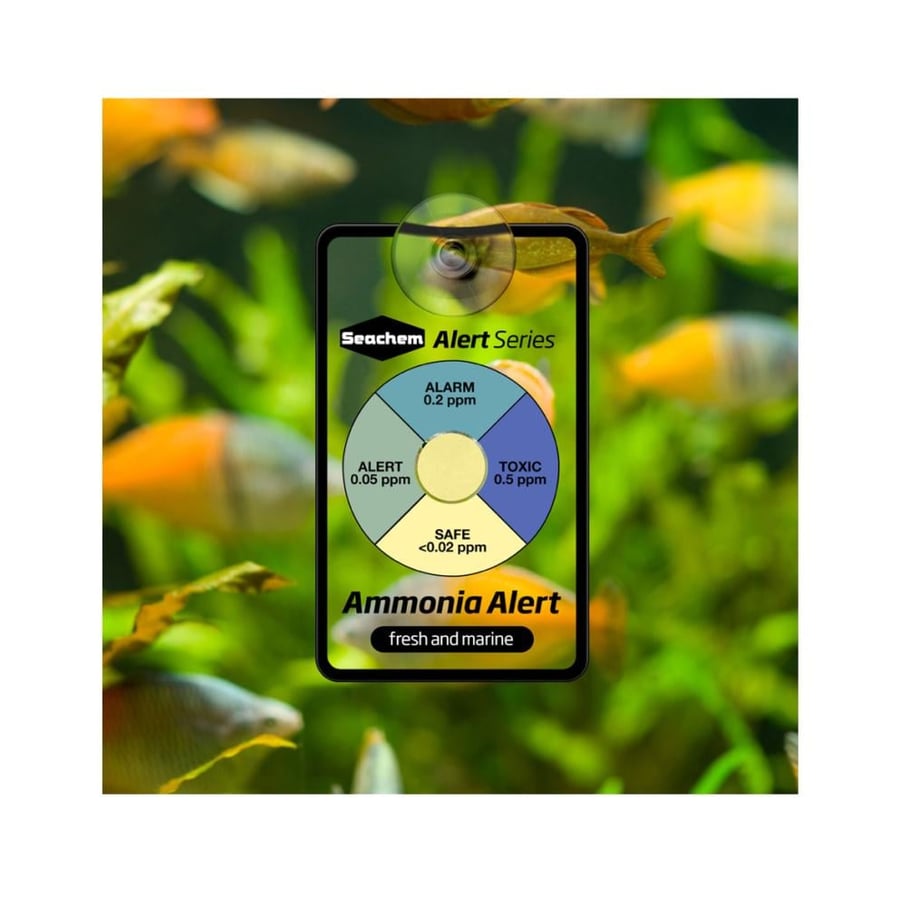
Seachem Ammonia Alert
79.93ر.س
Product description
Seachem Ammonia Alert®
Size and Contents
• Package: 1 Card.
• Dimensions: 1.5 inches x 2.5 inches.
Product Overview
Ammonia Alert® is an innovative color-changing device utilizing advanced Seachem sensor technology to continuously detect and monitor toxic free ammonia. It features a sensor that changes color reversibly—from yellow to green to blue—providing immediate, constant readings of ammonia levels.
Primary Uses
• Continuous monitoring of toxic free ammonia levels in freshwater and marine aquariums.
• Provides accurate readings starting below 0.05 mg/L (ppm), alerting you to danger before fish show signs of stress.
• A complete alternative that eliminates the need for test kits, chemical reagents, or complex procedures.
Benefits and Features
• Long-lasting: Effective for over a full year—nine times the lifespan of competing products.
• Smart Design: Approximately half the size of similar products; small, clear, and unobtrusive, preserving the aquarium's aesthetics.
• Continuous Monitoring: Responds quickly to changes, typically within 15 minutes.
• Early Warning: Protects against the aquarium's "#1 killer" using a clear, easy-to-read color-coded system.
Color Interpretation
• SAFE: Yellow (below 0.02 mg/L) – No action required. • ALERT: Light green (0.05 mg/L) – Tolerable for 3–5 days; monitor the situation and consider a water change soon.
• ALARM: Blue-green (0.2 mg/L) – Tolerable for 1–3 days; a water change is required soon.
• TOXIC: Blue (0.5 mg/L) – Highly harmful; change the water immediately or use AmGuard™ for emergency removal.
Usage and Care
• Placement: Simply hang the device in a visible location inside the aquarium.
• Care: Do not touch the sensor with your fingers, as skin oils may damage it. Clean off any algae with a soft, clean cloth; do not use soap or bleach.
• Verifying Functionality: You can confirm the sensor is working by briefly holding it over the opening of an ammonia bottle; the color should change rapidly.
Important Guidelines
• Not recommended for use in aquariums with acidic pH levels.
• When first installed, a dry sensor requires a few days to equilibrate with the aquarium water.
• For maximum sensitivity, read the results under natural daylight or daylight-simulating lighting.
