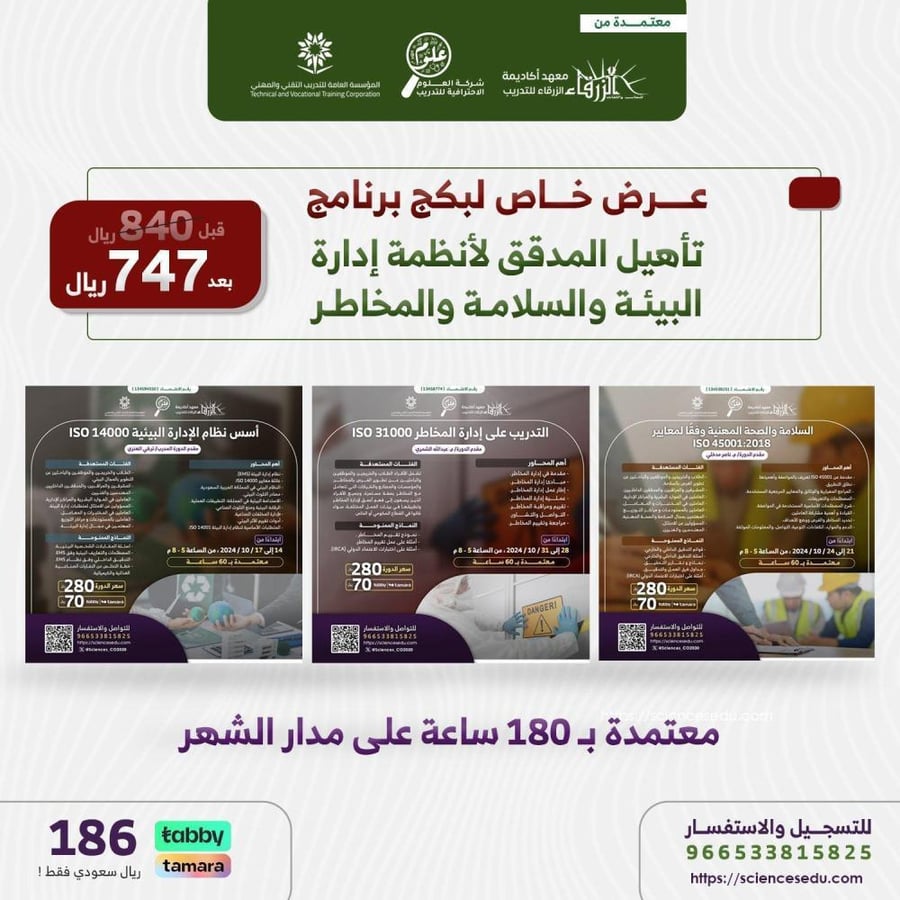
Package - Auditor qualification program for environmental management, safety, and risk systems
747ر.س
Out of Stock
Product description
45000 Topics: Introduction to ISO 45001, definition of the specification and its importance. Scope of application, defining the boundaries of the occupational safety and health management system. Normative references, documents, and reference standards used. Terms and definitions, explanation of the basic terms used in the specification. Context of the organization, understanding the internal and external environment that affects the system. Leadership and worker participation, the role of leadership and the importance of worker participation in the system. Planning, how to identify risks and opportunities and set objectives and plans. Support and resources, competencies, awareness, communication, and documented information. Operation, planning and control of processes to ensure occupational safety and health. Performance evaluation, monitoring and measuring performance, internal audit, management review. Granted models 🎁: Internal and external audit checklists, investigation forms and reports, work team tables, and audit questions. Examples of IRCA international accreditation tests. ISO 31000 risk management course focuses on providing a framework and principles for risk management in organizations. The main topics of the course include: 1. Introduction to risk management: definition of risk management and its importance. Explanation of risk management terms and concepts. 2. Principles of risk management: understanding the core principles, such as integration into all organizational processes, based on the best available information, and considering human and cultural factors. 3. Risk management framework: explanation of how to develop and implement a risk management framework within the organization. Defining the role of leadership and guidance in activating risk management. 4. Risk management process: steps of risk identification, analysis, evaluation, and treatment. 5. Risk assessment and monitoring: how to continuously monitor and improve the effectiveness of risk management processes. Performance review and ensuring sustainability. 6. Communication and consultation: the importance of internal and external communication regarding risks. How to involve stakeholders in the risk management process. 7. Review and evaluation of risks: ensuring the framework fits the changing needs of the organization. The importance of periodic assessment and continuous improvement. These topics help organizations build a strong and effective risk management system aligned with ISO 31000 requirements. Granted models 🎁: Risk assessment model, examples of risk assessment work, examples of IRCA international accreditation tests. Topics of 14000: International Organization for Standardization (ISO): its role and importance in standardizing global standards. Environmental Management System (EMS): the global concept and strategic objectives. ISO 14000 family of standards: an overview of integrated environmental solutions. The environmental system in Saudi Arabia: challenges and opportunities. Sources of environmental pollution: analysis of main aspects and impacts. Environmental sustainability in the Kingdom: concept and practical applications. Environmental control and industrial pollution prevention: effective methods and procedures. Industrial waste management: sustainable solutions and challenges. Environmental impact assessment tools: methodologies to reduce negative effects. Basic requirements for ISO 14001 environmental management system. Additional files: Environmental interview questions, environmental terms and definitions according to EMS, methods of disposing of industrial, food, and chemical waste, internal audit according to EMS system.
