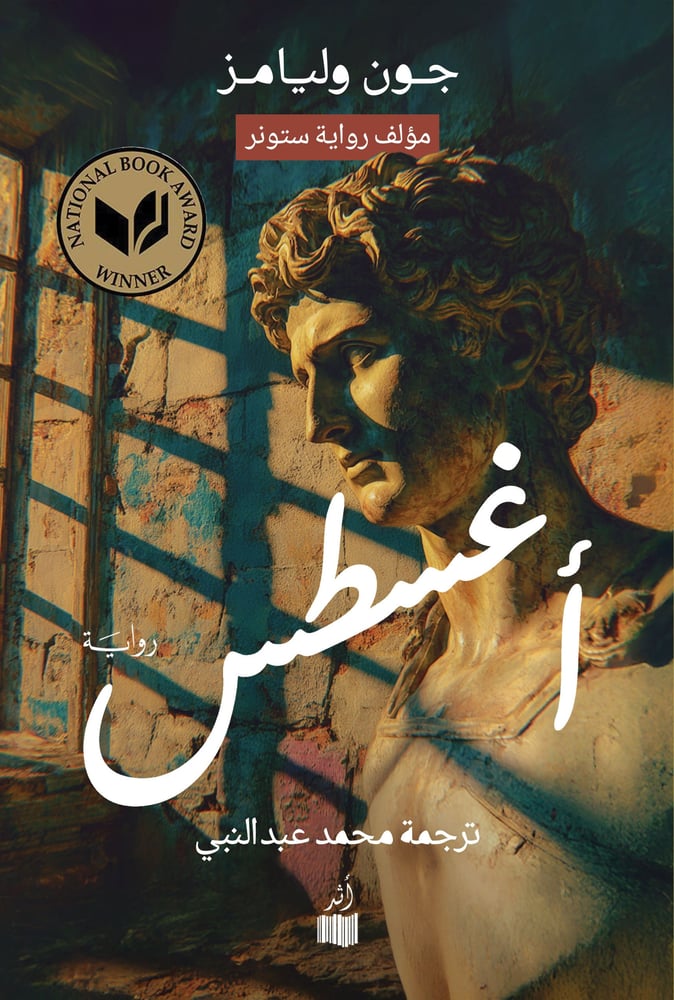
August - John Williams
60ر.س
Product description
John Williams, the quiet American writer in voice and intense in expression, who proved his great ability in his famous work Stoner, presents here in "August or Augusts" a remarkable and stern work and a documentary about the rise of a man from the margins of history to the peak of power, until his name becomes a mirror to the tragedies of isolation and human pain. The novel won the National Book Award in the United States (1973), and it is an acknowledgment of the work's status as a true literary achievement in the mechanisms of time and power. The novel does not narrate a traditional biography of (Octavian / Augustus) as the first Roman emperor, but constructs it from a mosaic of documents: letters, testimonies, reports, diaries, and accounts from those around him. This multi-voiced structure gives the reader a fragmented view of the man—not a single voice declaring him a hero—but reflections of others upon him, their shadows forming his image!! Thus, the character becomes a piece of a mosaic seen from different angles, and history becomes a novel written in the voice of others as much as it is written in his voice. At the core of the text are questions about the price of power: how do circumstances shape a man, and how do they consume him? Williams writes about small moments as much as he writes about great battles, a brief look leading to disappointment, a long silence turning an apparent matter into regret, a moment of retreat revealing the fragility of the leader behind his armor. The story begins after the assassination of Julius Caesar, where the political system in Rome collapses, and a sensitive and intelligent young man named Octavian emerges. From that moment, Rome transforms from a republic into an empire whose sun never sets; because Augustus was not just an emperor, but more like an engineer who reshaped Rome from within and outside, marking the beginning of an era of stability that made Rome the mistress of the ancient world. But the path ahead is fraught with a struggle between fear and ambition, between legacy and change! The language here is concise, clear, but hides within it cracks of reflection and exhaustion; the reader hears echoes more than statements, and the power of authority is closer to isolation, with many losses in exchange for what it gives—loss of friends, family, innocence, and even the self. In the end, it is not as it appeared in the chapters of the story—not applause for merit nor cheers for greatness—but a moment of reflection on what history leaves behind, and what is in the heart beneath the armor and the spirit beneath the body that bears its crown and burdens. Until we ask: do names endure to cover up pain, or is the persistence of a name sometimes harsher than oblivion? Was Augustus ultimately a maker of history or a character that history emptied itself to create?

Questions you might have