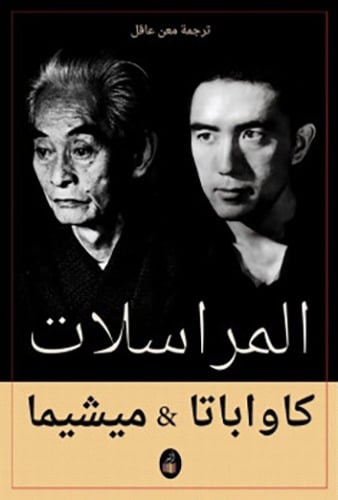
Correspondence - Kawabata and Mishima
51.75ر.س
Product description
The book of correspondence between Yasunari Kawabata and Yukio Mishima is a work that reveals the hidden side of two of the greatest voices of Japanese literature who received the Nobel Prize for Literature: the first, the poet of silence and fragile beauty, and the second, the writer of the body, willpower, and intensity. These letters are not only a literary record but a window into two completely different souls, connected through paper more than in reality. The book combines Kawabata's delicacy and calm concern with Mishima's passion, rebellion, and fascination with death, forming a duality that is hard to forget.
In these exchanges, we see Kawabata writing slowly, with few but full words, as if each sentence reverberates inside him before being released. Mishima talks about writing, about solitude, about the beauty he fears from modern noise. On the other hand, Mishima appears as he is: passionate, anxious, driven by life and death at the same time. He writes as he breathes… quickly, sharply, and painfully clearly. Through this deep difference, the book reveals the distance of friendship between two writers who only meet when literature becomes their common language.
What’s beautiful about these letters is that they reveal moments of weakness that never appeared in their published works. We read the heart of a shy person like Kawabata asking for an opinion without pride, and we hear Mishima trying sometimes to shed the image of the “warrior” he created for himself. They talk about the fear of emptiness, the difficulty of writing, the anxiety of time, and Japan’s rapid changes that do not suit their sensitivities. It’s as if the book places the reader in the middle of two spirits searching for meaning… each in their own way.
Ultimately, the correspondence between Kawabata and Mishima is not only a literary document but a testament to a friendship unlike others, and to a difference that creates a bridge that does not collapse. It is a book about literature when it becomes healing, and about words that give the writer the ability to see himself more clearly.
Was this exchange an attempt to get closer… or an attempt to avoid falling? Perhaps both. And maybe that’s why it remains alive in this way.

From Dammam