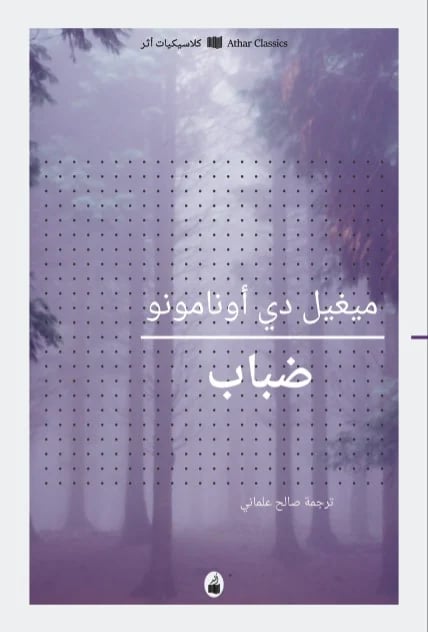
Fog - Miguel de Unamuno
51.75ر.س
Out of Stock
Product description
The novel "Fog" by the Spanish writer Miguel de Unamuno is not a novel in the traditional sense but rather a direct challenge to the very idea of the novel itself. Unamuno, the philosopher and thinker who wrote as if he were wrestling with questions of existence every day, presents in this work a text that offers not a plot but a broad anxiety: who are we? Do we choose our destinies or are we merely characters written by others? The novel places the reader directly into the consciousness of the protagonist "Augusto Perez," a man living his life as if wandering through dense fog, feeling his way but unable to find himself, clinging to ideas more than to reality. The novel jumps from scene to scene as if dismantling life into incomplete parts. Augusto, who initially appears as a simple man, transforms before the reader into a mirror of humanity’s worst fears: loneliness, doubt, the need for love, and the desire for a meaning that seemingly does not exist at all. In a satirical and precise manner, Unamuno describes the protagonist’s relationships with others as if they are characters moving around him without anyone touching his true essence. Even his love story does not come as a solution but as an element that thickens the fog, making him see himself from a harsher distance. Unamuno’s language here is inherently philosophical, yet strangely close. The sentences walk the line between seriousness and sarcasm, and the dialogues seem as if they are between two minds that disagree on everything. At the heart of the novel comes the greatest scene: Augusto’s encounter with Unamuno himself. Suddenly, the writer intervenes in the world of the novel to tell its hero that he is not a real person, and that his fate is in the hands of the writer alone. This meta-narrative explosion makes the novel not only a question about existence but also a test of the limits of literature itself. Can a character rebel against its creator? Does the writer have the right to write death as he writes life? In the end, Fog is not a novel to find a story in but to find yourself. It is a text that boldly approaches the reader and prompts him to ask: if Augusto is just a character written by Unamuno… how many of our lives are written without us even knowing?

From Dammam