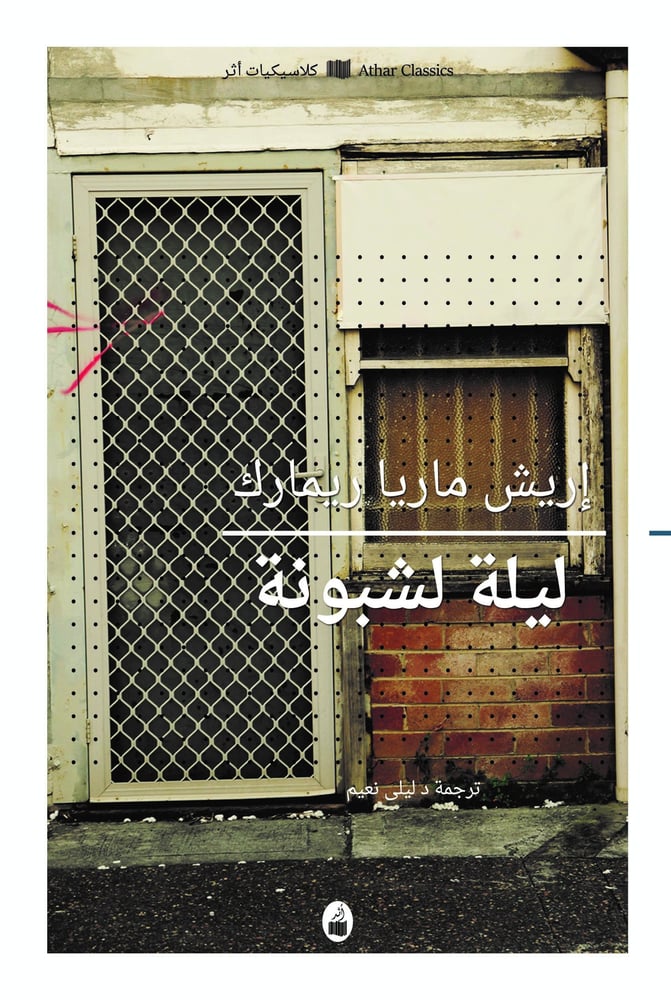
Night of Lisbon - Erich Maria Remarque
57.50ر.س
Out of Stock
Product description
The novel "Lisbon Night" by Eric Maria Remarque is a work belonging to those books that are read as if they are a late confession, its pages opened in a moment of distress when the heart finds no escape but in words. Remarque, the German writer known for his sensitivity to exile and loss, presents a text that takes place entirely in one night, but a night sufficient to bear the weight of a whole life. On this night, two men meet at the Lisbon port, one carrying a legitimate passport that allows him to escape, and the other carrying a story that cannot bear silence. The novel is built upon this encounter, as if it were a deal between life and storytelling: that you give me your ear, and I give you the truth I have hidden all my life. This simple structure opens a door to a deep narration, where memory intertwines with fear, love with erasure, and silence with the need to finally hear the voice. The unknown narrator finds himself listening to the story of a man who lived escape in both its literal and existential sense. A story that begins with quiet love, then turns into a series of pursuits resembling an attempt to catch light in an era of darkness. Between Germany, France, and Spain, the man recounts his journey with his wife "Helen"—a woman who does not live in a noisy world, but in that fragile space between dream and reality. Remarque writes about their relationship as a small miracle that happens against time, a relationship that does not try to conquer the world, but only tries to stay alive in a collapsing world. With each city they move to, the question grows: what do we truly carry with us when we escape? The body? Memory? or the person we fear to lose more than life itself? Remarque’s style here is governed by a subdued inner voice, like the breath before crying or confessing. Short sentences but filled with unspoken tremors, and calculated repetitions that make the narration closer to a sad hymn recited in a narrow room. The nocturnal atmosphere of the city, the humidity of the port, the light of the lamps on the water—all turn into a mirror reflecting the turmoil of the two characters. Lisbon in the novel is not only a city of escape but an ultimate stage to speak the truth, and here Remarque’s brilliance is revealed: turning one night into a spiritual extension that deepens the inner collapse of a person who lived his life as a shadow. In the end, Lisbon Night is not a novel about fleeing from war, but about escaping silence. It is a story of a person who can no longer carry his story alone, and of the tale that is only complete when it finds a listener who neither judges nor interrupts. A highly delicate text, showing that sometimes courage is not in facing danger, but in saying what we have long feared. And the question the novel leaves echoing in the reader’s mind after closing the page is: Was the man seeking salvation… or was he only seeking someone to hear his story before disappearing into the night?

From Dammam