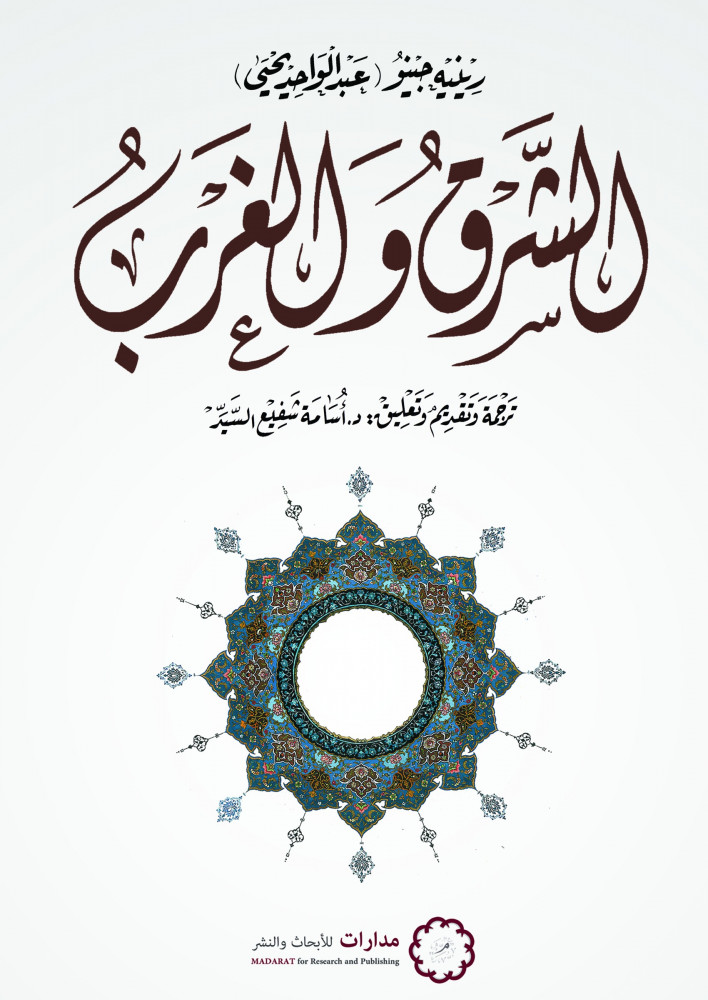
East and West
53.26ر.س
Out of Stock
Product description
In 1947, Dr. Ahmed Amin attended a conference on Palestine held in London, and there he observed a number of differences between what he was suffering from in his country and what he had seen in England. He dedicated himself to studying these differences, and the result was this book, "The East and the West." Ahmed Amin, who wrote "The Dawn of Islam" and "The Noon of Islam," was a historian and researcher in his time, and perhaps the year 1947 indicates a pivotal period in the relations between the East and the West. The 1940s was the time span in which this issue began to take shape, and perhaps Ahmed Amin's book "The East and the West" was a pioneer in its time.
In the introduction to his study, Ahmed Amin raises a central question: Is current Europe the result of its scientific and historical development, or did this development arise from it, its nature, and its circumstances? It is clear that Ahmed Amin's question did not come out of nowhere; at that time, there was a theory attributing Europe's economic and political development to its geographical and climatic nature: coldness and the geographical shaping that imposes strict internality on the regions and prevents their connection.
Initially, Ahmed Amin addresses the terms "East" and "West" and sees that they are broad, and that the clear distinction between them is meaningless. He concludes that geography does not constitute a decisive difference between them, and that modern Western civilization is not the highest civilization; it has shameful flaws, and despite being based on science, it is also marked by moral poverty. Among its flaws is that it reserves certain things for itself that it forbids others.
Regarding tyranny and democracy, the West has known strong dictatorships, while the East has experienced periods of justice. The West is not a place of democracy, nor is the East a fortress of tyranny. Among the flaws of modern civilization, according to Amin, are wars, racism, the worship of power, and the exaggeration of women's dominance over men. The Western city grew without a heart, even if its mind grew.
As for culture, Eastern culture has become twofold: inherited culture and Western tradition. The Eastern person emerges without either. The difference is also evident in social life: Westerners work a lot and sometimes fruitlessly, suffering from an excess of strength and production, while the Eastern may enjoy relaxation. The West is always optimistic, whereas the East tends toward sadness and pessimism. The individual in the West is independent, while the Eastern belongs to his family. Both have their flaws, but kinship and family have clear benefits; excess freedom here is like excess restriction.
Women in the West are independent, but in the East, she is primarily a mother, and Western independence risks compromising her femininity. Regarding imitation and innovation, Westerners tend to innovate, while the Eastern suffers not only from imitating the ancients but also from copying Westerners in everything. As for materialism in the West and spirituality in the East, both have roots deeply embedded in history.
In the end, the West is not the ideal, nor is the East; both complain of flaws and imperfections. The ideal is to combine science and religion, men and women, morality, benefit, innovation, imitation, materialism, and spirituality.
