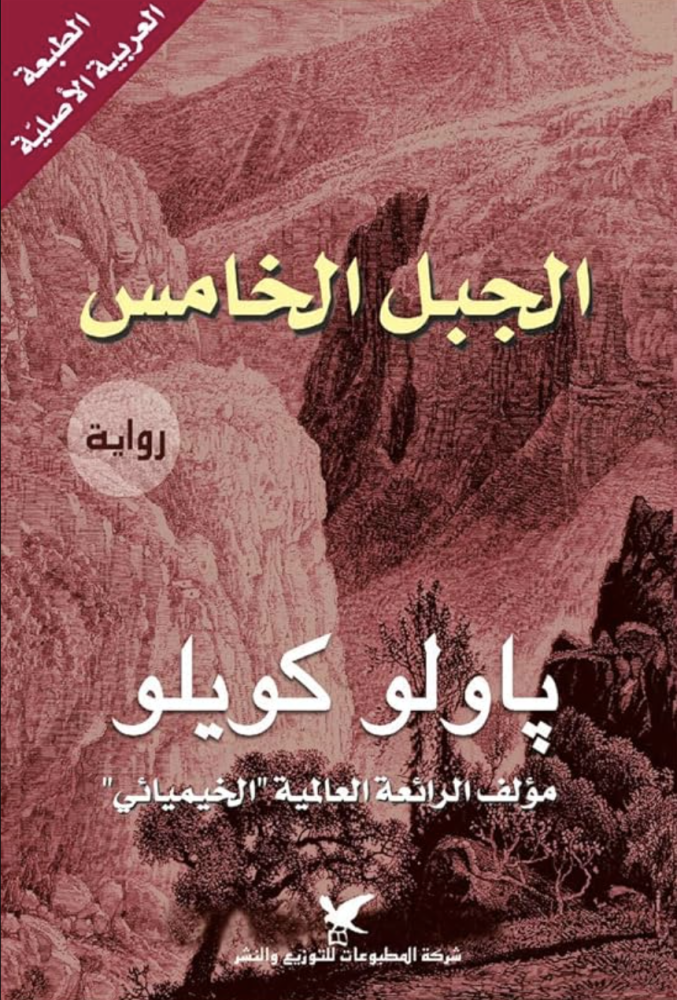
The Fifth Mountain
34.50ر.س
Product description
Paulo Coelho narrates in his novel "The Fifth Mountain" the story of the prophet Elijah and his encounter with the widow in Sarepta, the small Phoenician city; then his retreat to the mountain after defeating all his enemies. Elijah obeys his guardian angel's commands and constantly converses with him, trying to search for a new human meaning for decision and choice. In the city of Sarepta in Lebanon, which was destroyed by the Assyrians, Elijah loses everything: his courage, the woman he loved (the widow who helped him when he was hungry and thirsty), and his faith after the spiritual crisis that swept over him. Here, Coelho adds a new dimension to the image of the prophet Elijah, who is depicted as strong and invincible, carrying his sword to fight enemies. In this novel, Elijah fights against his own fear, a struggle between the divine and the human, between God's will, which the prophet cannot understand despite obeying it, and his own choices as a human. But what is interesting is that this text, in which Coelho relied on the Torah, took place in a city in Lebanon as the setting for its events, as if the author wants to say that history repeats itself in this country, from ancient times until today, where it paid the price for its love of tolerance, peace, and openness. In this book, Coelho raises questions that are fundamental to his literary, spiritual, and philosophical world: how can we give meaning to our lives through struggle and hope? Because the strongest moments of tragedy are not divine punishment, but rather a challenge posed to humans. Thus, Coelho gives a new meaning to punishment: what is inevitable in our lives and what we believe to be fixed is actually transient. The fixed is what we can derive from the lessons of the inevitable tragic.
