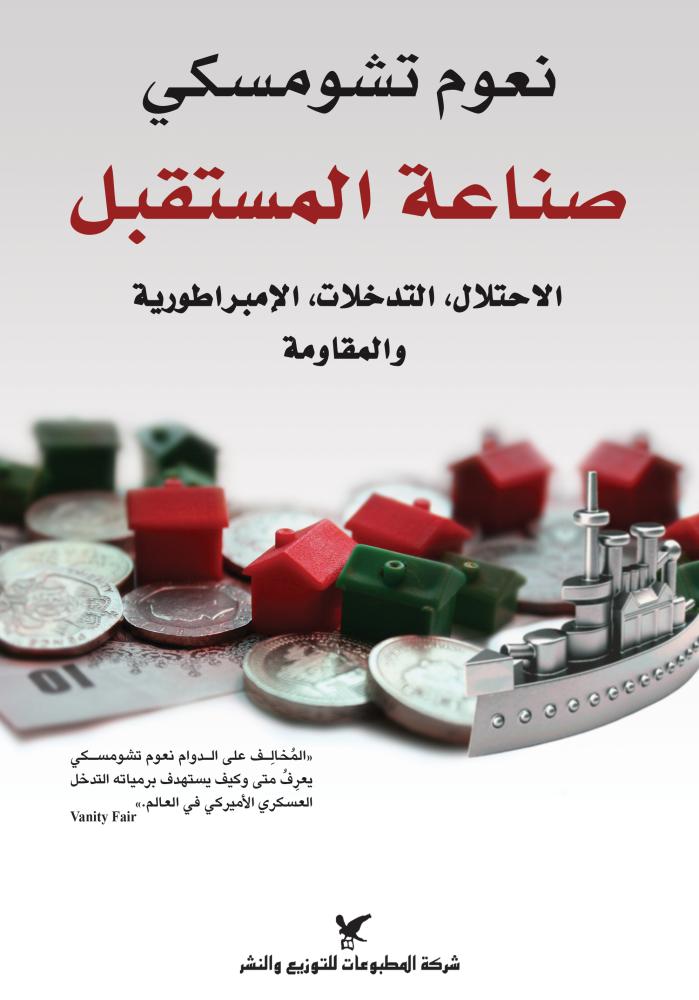
Future industry
43.13ر.س
Product description
Articles forbidden from publication, and articles published but suppressed because they opposed the official narratives of major political events, are both gathered in this book by one of the most important political opponents and the author of the monthly column in The New York Times, Noam Chomsky, with boldness and challenge. More than fifty analyses address American foreign policies that threaten the United States in its entity and existence, as well as its wars in Afghanistan and Iraq, and the rise of China. The shift of Latin America to the left. The danger of nuclear proliferation in Iran and North Korea. Israel's invasion of Gaza and the expansion of settlements in Jerusalem and the West Bank. Climate change, the Arab Spring, the assassination of Osama bin Laden; and the Occupy protests. American domestic policy including the US presidential race, the turbulent financial crisis, the social welfare system and its imbalance, the ruthless dominance of the industrial complex, and the unchecked military spending that is protected from any interference. The book "Making the Future" reflects a commitment to democracy and the strength of popular struggles, especially the Occupy movement around the world, which must fight a continuous war—not just every four years—against violations, inequality, and corporate arrogance. A book that may cause controversy for some readers deceived by misleading American politics, but its sharp perspective on issues and its fierce advocacy for struggle and rebellion help the vast majority make decisions and prevent anyone else from executing the task of shaping the future.
Noam Chomsky is a philosopher, linguist, cognitive scientist, logician, historian, critic, and American political activist, born in 1928. He is an honorary professor of linguistics in the Department of Linguistics and Philosophy at the Massachusetts Institute of Technology, where he worked for more than fifty years. Chomsky is considered one of the most prominent intellectuals in the world. He is also ranked eighth among the most cited references of all time, in a list that includes the Bible, Karl Marx, and others. He is also described as the father of modern linguistics and is regarded as a key figure in analytic philosophy. His work has influenced many fields such as computer science, mathematics, and psychology. He is also credited with founding the theory of generative grammar, often considered the most important contribution to theoretical linguistics in the twentieth century. Additionally, he is credited with establishing what is now known as Chomsky hierarchy, the theory of universal grammar, and the Chomskyschutzenberger theory.
He is famous for his critique of U.S. foreign policy, state capitalism, and the mainstream news media, and has written more than a dozen books on wars, politics, and media.

Questions you might have