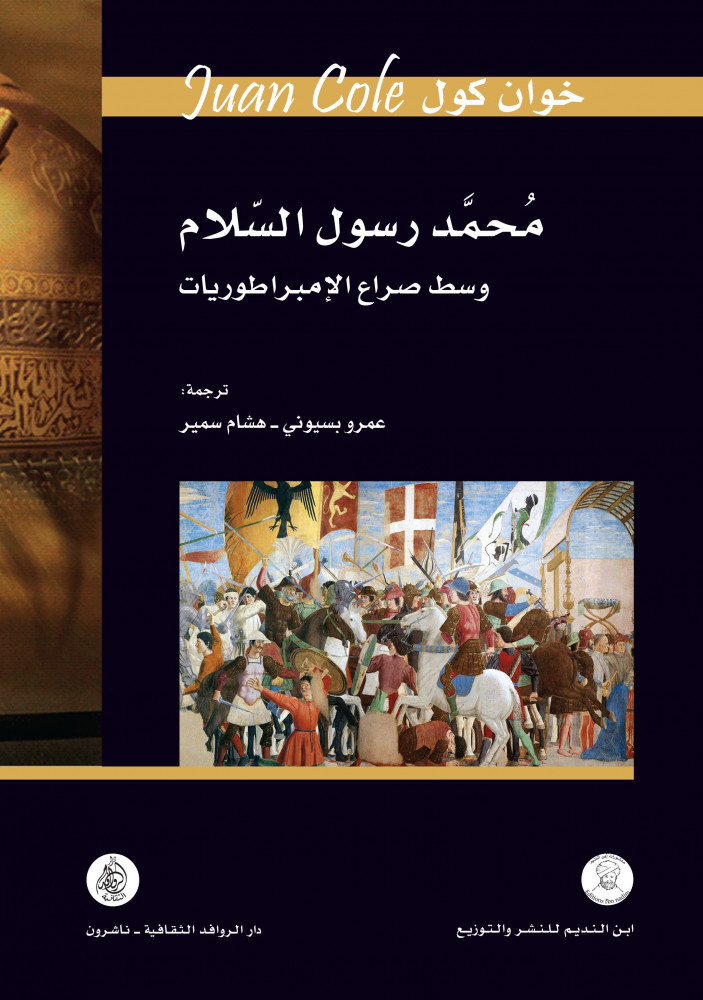
Mohammad, Messenger of Peace, amidst the conflict of empires
64.69ر.س
Out of Stock
Product description
Amidst the conflicts in the world and what is happening of wars and problems among the global powers, the book Muhammad Messenger of Peace was published in English by its author Juan Cole; after it was presented to us, we, Dar Al-Rawafid Al-Thaqafiya and Dar Ibn Al-Nadim, decided to publish it without hesitation; noting that the approach of the book's subject differs from the topics of our books; nonetheless, we proceeded to translate, print, and publish it to fill a gap that was filled and still is in our Arab libraries, especially regarding a subject related to our Prophet and beloved Muhammad, peace be upon him, and what he offered to the world in a Western tongue. This book presents a model of scientific opinion that the author strives hard to reach, and expresses it in language that compels its reader even if they disagree, in a respectful manner in its discussion. The Muslim reader may be in no need of knowing about the Lord of mankind, peace and blessings be upon him and his family, but still, they cannot claim that the door has closed at any time to explore the depths of the great personality of the Prophet, peace be upon him, in search of more and more of its precious treasures. No matter what the Arabic reader's opinion of the author's scholarly effort, they will at least see the vast difference between the (scientific opinion) that the West has raised its banner (theoretically) and the (political nonsense) that the West has practiced (in reality) and issues to us under the cover of freedom and democracy. Nevertheless, there are those who promote it in the East under the pretext of the same false slogans that find no practical response from the Western camp itself, higher than the effort of this academic writer (Juan Cole), who gives a lesson to the claimants of freedom with the level of effort and responsibility befitting the free.
The author of the book attempted to answer several questions regarding whether Prophet Muhammad, peace be upon him, imposed the new religion by the sword. The book states that non-Muslims who find time to read the Quran feel confused, because they will read a lot about the prophets Abraham, Joseph, Moses, and Jesus, but they will not find much about the Prophet of Islam, Muhammad, peace be upon him; although the Quran addresses Muhammad, it does not speak about him much. Mustafa Akyol, a researcher at the Cato Institute in Washington, wrote that Islamic heritage produced many literatures about the life of the Prophet, peace be upon him, and his era, called the books of Sirah, and considered that the book adds to this accumulated knowledge. He said that the author of the book is characterized by abundant information and broad knowledge, and approaches the topic through two non-traditional arguments linking the dawn of Islam in the early 7th century in the Arabian Peninsula with the major geopolitical conflict at that time between the Christian Byzantine Empire in Constantinople and the Sassanian Zoroastrian Empire, known today as Iran. He supported this view with the opening of Surah "Ar-Rum" in the Quran, where Allah says: "The Romans have been defeated in the nearest land. But they, after their defeat, will overcome. Within a few years. To Allah belongs the command before and after. And that day the believers will rejoice." Cole sees that this verse has long been an indication of the early Muslims' sympathy with the "monotheistic" Christians in their conflict with their pagan enemies. The second hypothesis he based on goes in the opposite direction of the prevailing theories and images about Prophet Muhammad, peace be upon him, in the West, describing the Messenger of Islam as a man of peace who sought to spread his monotheistic creed and tried to establish a harmonious, multicultural environment. The author built this hypothesis on the early years of Muhammad's mission and the persecution faced by the Messenger in Mecca, stating that the wars fought by the Prophet in later stages were defensive in nature and within the concept of "just war."
