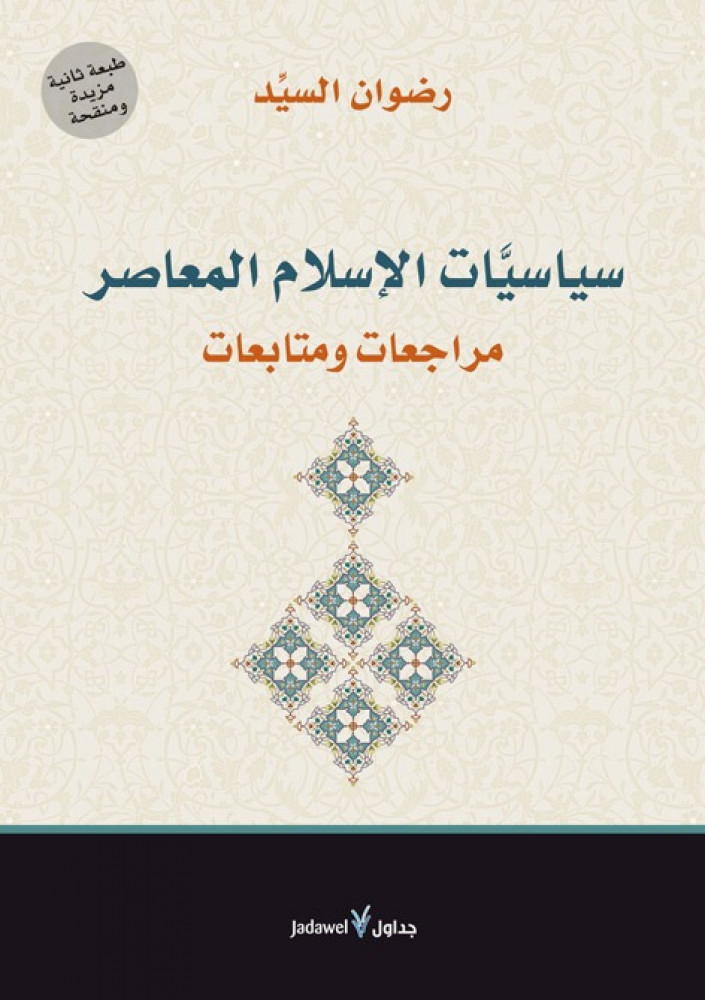
Contemporary Islamic policies
49.16ر.س
Out of Stock
Product description
This book compiles research conducted by the author in the first half of the nineties of the last century. It studies the facts of the emergence of "Political Islam." The term that appeared in the second half of the seventies of the last century refers to movements and parties aiming to establish a state or political system based on a new model called: the Islamic State! The book's chapters include a study of the processes of Islam politicization from two perspectives: the first perspective involves methodologies that include efforts to transform concepts through foundationalism, meaning surpassing tradition or historical experience and relying on the Quran, Sunnah, and the experience of the Rashedin, and through interpretation and synthesis in modernizing contexts that created a complete system based on applying Sharia, also in its new concept! The second perspective concerns events and facts over three decades, during which most of the Islam politicization occurred. These events and facts address several issues; the first is the stage of the religious and conceptual tradition-based party during the twentieth century, the party formation of Salafi movements, their relations with Arab and Islamic nation-states, then the communication, intersection, and disconnection between theory (the complete system or sovereignty or applying Sharia) and actions on the ground in forms of conformity and divergence with existing conditions, and the explosion of Jihadi Islam. The first edition of this book was published in 1997. It quickly sold out and was subject to severe criticism from Salafis and liberals alike. The Salafis considered the book unjust and biased, as it portrayed the Islamic phenomenon as a schism in religion. The liberals criticized it because they saw it as an idolization of rigid tradition and a justification for the conservative trend in Islam. The book included a new introduction by the author, as well as corrections and omissions in the text, which he believes remain highly valuable for those wishing to understand the formative experience of Political Islam.
