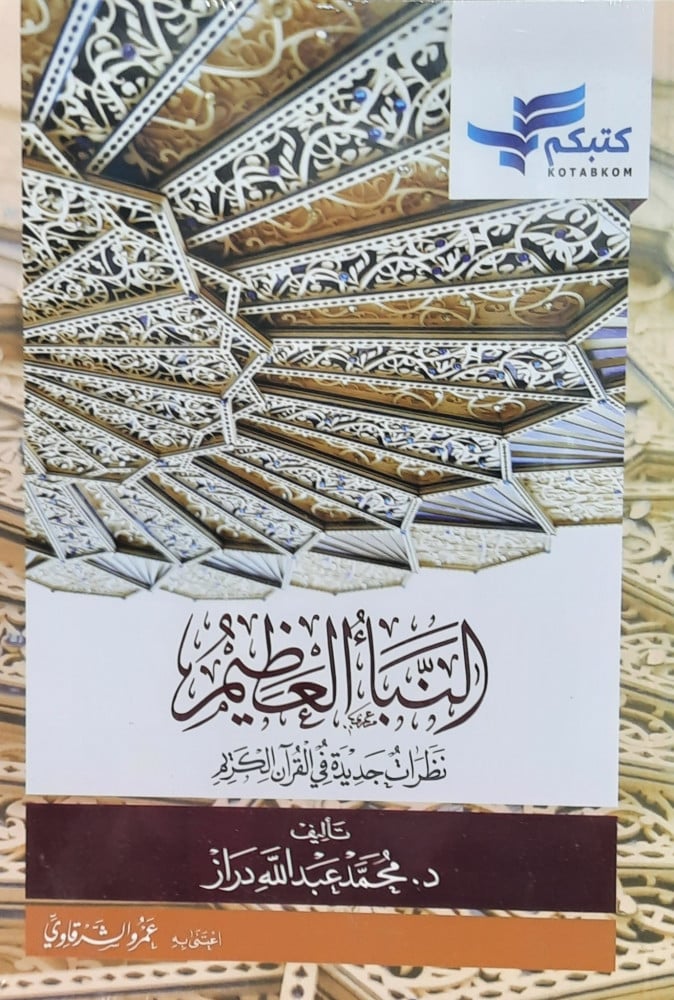
The great news
45.07ر.س
Out of Stock
Product description
No one can fully and sufficiently grasp the personality of Imam Ali (may Allah be pleased with him) through his study; the pens have failed to enumerate his knowledge, manners, wisdom, justice, bravery, and his support for Islam. He was the first to embrace Islam and believe in the Messenger of Allah (peace be upon him), and to verify his speech. He was the one who was raised in the embrace of the Messenger of Allah (peace be upon him) and was disciplined by his manners. He is the one who alleviated the distress of the face of the Prophet Muhammad with his sword, and he sacrificed himself for him during his migration (peace be upon him) to Medina. He (may Allah be pleased with him) was the same as the Messenger of Allah when he challenged the Christians of Najran, and he was his guardian over the servants of Allah after him, after the revelation of the verse of Tabligh: "O Messenger, deliver what has been revealed to you from your Lord, and if you do not, then you have not delivered His message. And Allah will protect you from the people." And Allah, the Most High, bestowed His blessing upon His noble Prophet with Fatimah al-Zahra, who is the mother of her father, and the leader of the women of the worlds, and the beloved of her mother Khadijah. She is the one whom Allah commanded His Prophet to honor and revere, because of her high status and prestige with Allah. When she grew up and was nurtured in her father's embrace, Allah commanded that she be married to the Commander of the Faithful, Ali ibn Abi Talib (may Allah be pleased with him), because he was suitable for her, and she was suitable for him. Without him, no one among the people would have been suitable for Fatimah al-Zahra.
In this love and loyalty to the Commander of the Faithful (may Allah be pleased with him) and Fatimah al-Zahra, the author has written about her, tracing her sayings, her rank with Allah, her sayings of the noblest Prophet Muhammad (peace be upon him), and what is documented in books and histories—old and new. It can be said that the topics covered in this book are among the most important, and no matter how much research is done, there will always be numerous benefits. Perhaps the most important of these is to remind of the role of Prophet Muhammad (peace be upon him) and his successor Ali ibn Abi Talib (may Allah be pleased with him), in addition to their role in resolving the ongoing intellectual conflict between two fronts: one aiming to preserve the message of Muhammad (peace be upon him) and the salvation it offers to humanity, and the other aiming to undermine the character of Muhammad and the prophetic entity he carries, leading to a backward, hostile, and extremist society.
Therefore, it can be said that the character of this book is a doctrinal, modern, and historical approach, exploring issues related to the personality of Imam Ali (may Allah be pleased with him) and its connection to the personality of the Seal of Prophets (peace be upon him), supported by Quranic evidence and noble Hadiths, and drawing on various contemporary historical or political studies cited to strengthen the argument or to respond to them.
What distinguishes this book most is that its author does not limit himself to sources specific to a particular school of thought, but continues to apply comprehensiveness and objectivity without extremist or biased perspectives. Due to the importance of this book, it was acquired through a process of verification, meaning its text was prepared for the reader in a clear, understandable manner, with explanations of some ambiguous words in the margin to enable the reader to benefit fully from this important book.
In addition to that, after editing the text, the Quranic verses were referenced, and the same applies to the narrations, which were traced back to their original sources, with notes on any discrepancies or uncertainties in the transmission by the author, including what was not mentioned in the original manuscript and was added with references in brackets, or by mentioning it explicitly, to keep the text intact in some parts and preserve the original manuscript as it is. Also, references were provided for what the author indicated in the context of the discussion. All of this was accompanied by a brief translation of the figures in the book and a translation of the author as well, based on available sources. An index was added at the end of the book for the surahs and Quranic verses mentioned in the manuscript, as well as those referenced in the margins by the author, arranged according to the order of the Mushaf. Finally, a list of sources and references used, arranged alphabetically.
