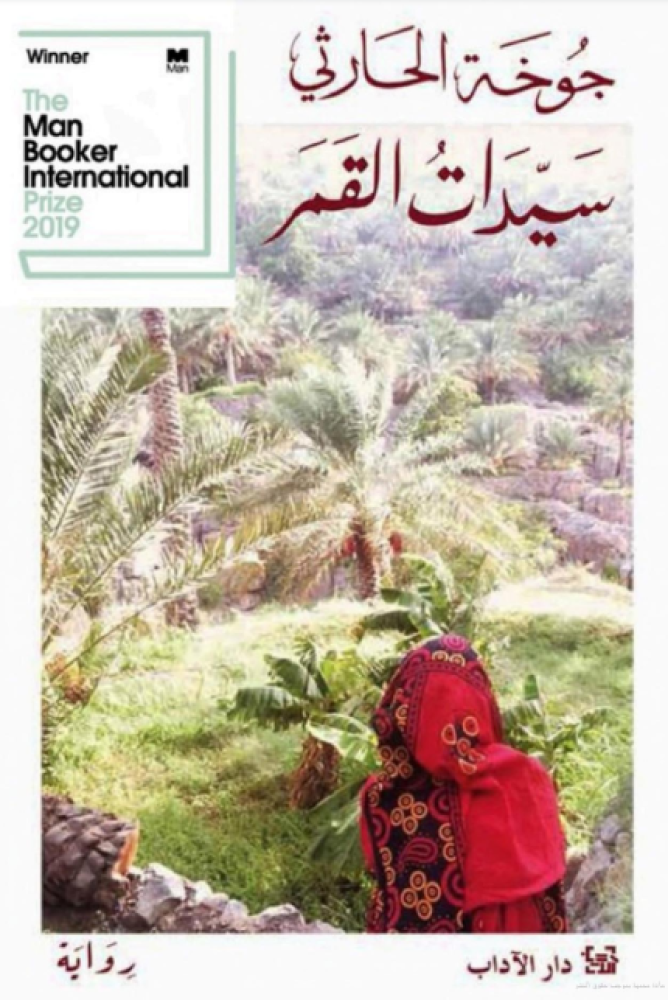
Ladies of the moon
38.81ر.س
Out of Stock
Product description
The events of the novel "Ladies of the Moon" take place in the fictional Omani village of Awaafi, and the novel intersects significantly with the events of Omani history from the 1930s to the 1980s. Despite its contact with history, the novel does not provide a historical record of that period, but instead, it weaves history with the stories of the heroines to show how women interacted with the movement of modernization in the Sultanate. The novel tells the story of three women: Maya, Asma, and Khawla. Maya, the first female character introduced by the novel, is a girl who falls in love at first sight with a man after meeting him in a public place, and she only wishes to see him from afar because society does not allow her to live a love story. However, even her hidden love inside her does not last, as her mother tells her about her engagement to the son of a merchant whom she later marries, and she names her first daughter "London" because the young man she loved traveled to London. Through Maya's story and her husband Abdullah, Johaqa Al-Harthi narrates much of the folklore of the past Sultanate of Oman. Asma is a girl who obeyed societal traditions and decided to marry in search of security and reassurance, to satisfy the demands of social duty. As for Khawla, she is a girl who rebels against societal norms and refuses marriage, waiting for her lover who failed academically in Canada. When he returns, she marries him, but she discovers he was involved with another woman in Canada, so she decides to divorce after ten years of marriage. French philosopher Paul Ricoeur says that the novel can reveal what history cannot discover, and sociologist Alain Touraine believes there is a certain overlap in the narrative level between a personal biography and a historical situation, where the personal circumstances of the fictional characters intertwine with the broader historical context of the place of the events. The novel "Ladies of the Moon" presents, through its characters, the social and cultural reality of the Sultanate and the political and urban transformations Oman has experienced, across two different generations. On the margins of the characters' stories, we discover tales about the community of slaves and maidservants and their suffering on ships they were crammed into after being kidnapped from African countries and sold to traders and sheikhs in the Gulf. Then came the law of emancipation, and many fled to other places outside the Sultanate, leaving the old generation still trapped in the idea of slavery as a fate. On the sidelines of the events, there is a relationship between the father of the girls and a liberated African woman, whom he loved so intensely that he recited Qays bin Al-Mulawwah’s poetry to her, but he did not marry her because her lineage was from enslaved women in the past. The novel "Ladies of the Moon" relies on multiple narrative voices, not on a single narrative voice, but on the technique of diversity and variation, according to a systematic movement of moving back and forth in time. The multiple voices contributed to presenting different perspectives and breaking the monolithic view offered by the single narrator of the events and facts of the novel. Between these diverse voices, the movement of life in the novel shifts from calm and stillness, where Maya speaks, to the noise of the city and urbanization, when the narration moves to her daughter London, who loves her university classmate and insists—unlike her mother—on being with him despite the huge class differences. However, she leaves him when she discovers his repeated betrayals. "And who mourns my sadness?" remains the question Maya asks, hanging without an answer until the end of the pages. All the heroines of the work have experienced emotional betrayal, and all of them have suffered loss and fragility. Disappointment in love is a common trait among them because most characters kept searching throughout the novel for something missing... something stolen... a lost time and a life that no longer exists. Perhaps that is why the idea of conflict in its confrontational dimension is absent from the events; each character struggled internally, digging deep into themselves to find a place in life. Although the novel appears to be a work dedicated to women, it actually transcends them and uses storytelling to interrogate history and launch from it through women, shaping dramatic worlds for a reality that is bubbling with many changes beneath its surface. Aside from the women's stories, the novel provides a comprehensive picture of the beauty of the desert environment of Oman, its people, customs, and societal traditions. In the absence of sociological studies about the Gulf countries, literature remains the window through which we glimpse different societies: how they began, how they developed, the impact of oil economy on urbanization, and how people changed. All these matters are narrated in the novel, especially in tracking the urban transformation from the village of Awaafi to the city of Muscat. The author managed to present a rich and fertile world filled with contradictions, where love, longing, and disappointment intertwine with feelings of alienation, loss of dreams, and clinging to them. All these emotions are strongly merged with the political, economic, and social transformations in the country. Therefore, the structure of the novel is based on connection and separation simultaneously, and breaking the monolithic view allowed for graceful movement between different times and places. For this reason, "Ladies of the Moon" can be considered a generational novel, despite not strictly adhering to this classification, as it did not span many pages but at the same time invoked different eras of Omani history, from the colonial period, through the emergence of the Sultanate, to the spread of modernization and contemporary urban development.
