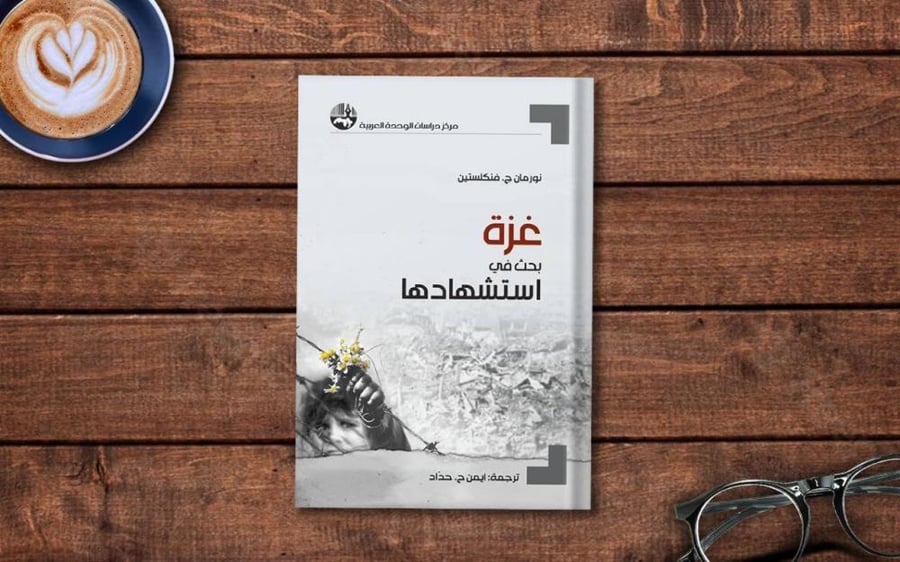
Gaza: Research on her martyrdom
77.63ر.س
Product description
Exploring the depths of human brutality is a difficult task, and certainly not an enjoyable one. The researcher Norman Finkelstein tackled this task with solid arguments, clear emotion, and extensive research in his remarkable book Gaza: A Research on Its Martyrdom. And while he says that "this book expresses successive emotions of anger and resentment," it is hard for us to see how anyone with even a small amount of humanity would not feel these emotions in light of the dark record that appears in this book.
Impactful reports have been issued, often shocking, recounting the tragedy of Gaza, and among the most irritating are the live testimonies from the field during the periodic escalation of crimes committed against Gaza. Studies have also been published by high-level investigative committees authorized by major international groups concerned with human rights, all of which Finkelstein examined in his research. There are also other works produced by prominent journalists and researchers that have enhanced our understanding of the events. However, Finkelstein’s research, with its broad scope, thorough study, and sharp critical analysis, stands alone in its special position.
Finkelstein, at the end of his research, points to warnings from the United Nations Conference on Trade and Development (UNCTAD) and other international monitors that Gaza could become uninhabitable, literally, starting from 2020, "due to ongoing development discouragement, eight years of economic blockade, and three military operations" between 2009 and 2014.
After a visit by UNRWA Commissioner-General Pierre Krähenbühl to health centers in Gaza following the Israeli atrocities in spring 2018 [during the Great March of Return], he said he found "shocking scenes that evoke deep discontent," including "the pattern of entry and exit of bullets from the bodies of the injured, indicating the use of ammunition intended to cause severe damage to internal organs, tissues, muscles, and bones." Israel pretended that security motives drove these crimes, but Finkelstein reviews these cases in detail and shows the falsehood of this pretense; it was enough for Israel to implement a constructive solution to block desperate people facing disaster, who are demanding to return to the homes from which they were violently expelled. Violence could have been avoided if Israel had accepted Hamas’s repeated offers for a long-term ceasefire (truce). Israel ignored these offers without even commenting on them.
Finkelstein discusses Israel’s "separation" in September 2005, during which Israel continued to be an occupying force, a fact even acknowledged by the United States. By then, Israeli extremists understood that it was not worthwhile to deploy a large part of the Israeli army to protect a few thousand settlers occupying large parts of Gaza and monopolizing its scarce resources. Dov Wingleas, the authorized official, explained the official logic of the withdrawal: it would "freeze" the political process and prevent the establishment of a Palestinian state. He added that Gazans would remain committed "to a diet, but without pushing them to die of hunger," which would not look good in front of the world. These instructions were followed precisely by experts, but there are current concerns that the strangulation process might be so severe that avoiding a global reaction could become impossible.
In November 2005, a ceasefire agreement was reached. The agreement held for a few weeks until the Palestinians committed a major crime: they held elections considered free and fair, but they elected the wrong side: Hamas. Israel and the United States responded by escalating violence and imposing severe sanctions, followed by Europeans with trepidation. The United States resorted to its standard procedures in such cases; they organized a military coup, but Hamas preempted it in 2007, which was a greater crime on Hamas’s part and brought harsher punishment upon it.
Finkelstein reviews these events and their aftermath in a detailed and comprehensive manner. He clarifies that the basic pattern is the signing of a ceasefire agreement, which Hamas adheres to, but Israel disregards and decides to escalate violence periodically, provoking a response from Hamas, then Israel uses this response as a pretext for its next operation "to trim the grass," as the Israeli expression goes. This is accompanied by condemnations of Hamas’s terrorism, which American commentators often repeat, as do European commentators.
Finkelstein subjects these Israeli escalation justifications to precise analysis, convincingly showing that they have nothing to do with Palestinian violations. Instead, they stem from Israeli strategic needs: to demonstrate deterrence by destroying Gaza after Israeli failures, as in Lebanon in 2006; or to prevent reaching a political settlement. As Finkelstein discusses, there is a particularly serious threat: the potential unity between Hamas and the Palestinian Authority, which could undermine Israeli excuses for avoiding negotiations and threaten the American-Israeli plan to separate Gaza from the West Bank, a plan that began implementation shortly after the Oslo Accords, which obligated the signatory parties to respect the territorial unity of the occupied lands.
Finkelstein explains that his main subject is "reports concerning human rights in Gaza," which are generally numerous, and "committed to standards of accuracy, recording the history of misery, suffering, cruelty, and criminal injustice." The fate of these reports, like the economic reports Finkelstein reviewed, was neglect, except for a narrow cadre of specialists— and "ultimately, human rights circles themselves succumbed to Israel and its rampant power."
Finkelstein scrutinizes this latest "treachery" with his scalpel, serving as a shameful proof of Israel’s opportunism and the cowardice of Western countries; after reviewing Goldstone’s report (which concluded inevitably that the Israeli army’s criminal atrocities and its effort to "humiliate the Palestinian people and degrade their dignity" are "deliberate policies"), he dedicates a revealing chapter to the malicious attack that ultimately left Goldstone a broken man, forced to disavow the report issued by his own committee—disavowal that he alone made, while other committee members stood firm and emphasized their conclusions. As Finkelstein demonstrates, Goldstone provided no basis for his disavowal, but due to the personal attacks he faced and the hateful smear campaign, including attacks on his personal life, he is difficult to criticize.
This campaign also intimidated others, especially Human Rights Watch, which faced a "vicious campaign" coordinated not only by "chronic Israel apologists" like Alan Dershowitz and Eli Wiesel, but also by another group of individuals. By the time of Operation Protective Edge in 2014, Human Rights Watch had withdrawn from the scene, and its work barely surpassed the repeated condemnations issued by the UN Secretary-General and the usually submissive Obama administration. Finkelstein argues that Obama should be considered the "main facilitator" of this brutal crime, as he refrained after his election in 2008 from commenting on the preceding crime, Operation Cast Lead, which stopped—coincidentally—at the moment Obama took office, allowing him to issue a call that made him appear as a sober statesman, looking toward the future and leaving the past behind.
Finkelstein then turns to a comprehensive analysis of the investigations conducted by Amnesty International regarding Operation Protective Edge—"the most destructive Israeli attack among recent Israeli assaults on Gaza," surpassing even the heinous crimes committed during Operation Cast Lead. He concludes that Amnesty International, "instead of remaining silent about Israeli crimes during Operation Protective Edge," following the path of Human Rights Watch, "worked to exonerate Israel from these crimes," and instead focused on Hamas’s retaliatory violations of human rights law, which are barely comparable to Israeli violations.
When Israel succeeded in neutralizing human rights circles, "its only remaining source of annoyance was domestic criticism," most effectively expressed by testimonies from soldiers of the organization Breaking the Silence. Soldiers who dared to reveal the actions of the "most moral army in the world," as they describe themselves, were not spared from severe attacks. Alan Dershowitz declared, "They are not telling the truth," considering this statement sufficient to settle the matter.
Finkelstein emphasizes that the real blow against Gaza’s residents is the long-standing blockade, designed to prevent normal life or recovery from the successive cycles of "trimming the grass." Brave and honorable attempts were made to bring desperately needed aid across the sea; Israel confronted every aid convoy with violence. Finkelstein dedicates a long section to the worst episodes of this violence, including the attack on the Mavi Marmara ship, which is a horrific display of brutality and cowardice, followed by cover-up fabrications under pressure from the United States and Israel.
In the appendix, Finkelstein carefully reviews the legal precedents, especially related to South Africa, establishing the conclusion that the occupation itself, not just its enforcement measures, "has become illegal under international law." This appendix is itself an authentic and important contribution to the field.
At the end of his research, Finkelstein recalls the astonishing narrative presented by researcher Helen Hunt Jackson in her book A Century of Dishonor, published in 1881, about "the events of destroying the native Americans under a conscious and deliberate government policy." The book was ignored and forgotten, but was rediscovered after about a century, due to the influence of popular political activism. Finkelstein states, "This book traces the bitter eulogy issued by Jackson." He expects that his own painful research will be ignored and forgotten, as Jackson’s book was, but perhaps one day it will be discovered, driven by outrage over what happened to people "betrayed by greedy, cowardly, opportunistic, mortal men."
There is still time to act, but if Finkelstein’s diagnosis is correct, "the black record of Gaza’s martyrdom" may soon become difficult to correct.

Questions you might have