Salt Cities 1/5
280.31ر.س
Product description
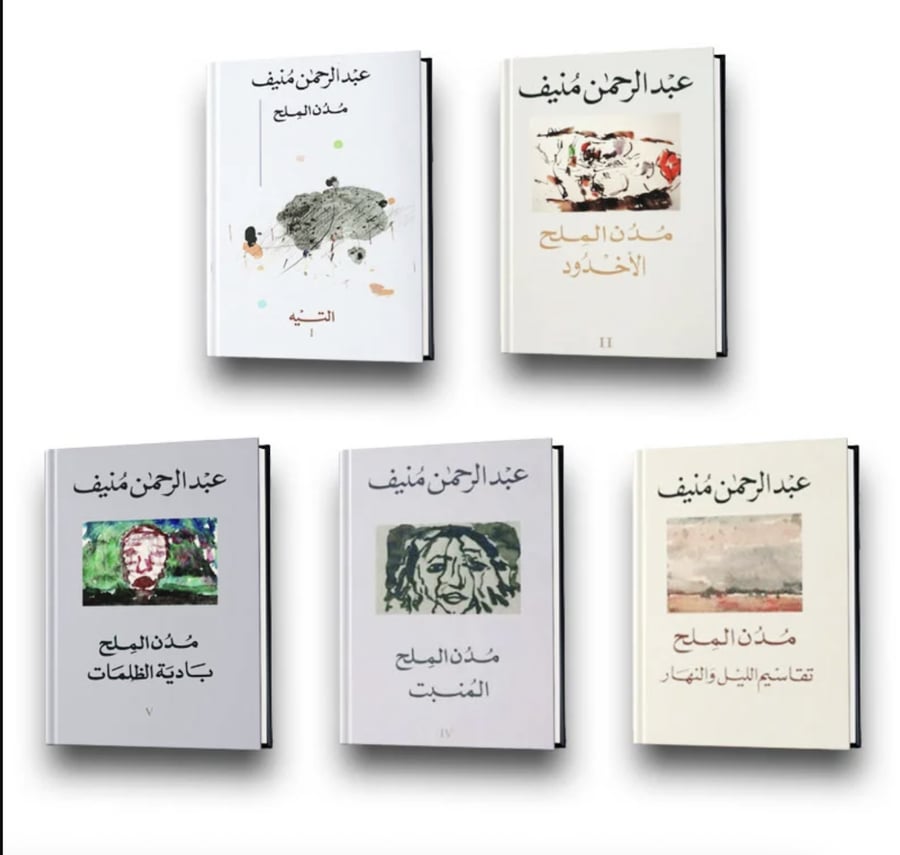
The book "Cities of the Salt Trilogy" by Abdulrahman Munif depicts life with the beginning of oil discovery and the rapid transformations that befell the cities and villages of the Arabian Peninsula due to the oil discovery.
Parts of the book "Cities of the Salt Trilogy" by Abdulrahman Munif:
The first part, "The Wandering," discusses the early signs of oil emergence in the Arabian Peninsula through its inhabitants, and features the character Metab Al-Hathal, who refuses as an expression of the spontaneous stance of the landowners, which forced the authorities to use violence.
This part describes in detail the construction of new cities and the harsh and stormy changes on the spatial level, especially the human level.
The second part, "The Trench," from the parts of "Cities of the Salt Trilogy" by Abdulrahman Munif:
In the second part, Munif moves to depict the authorities and politics in the desert, which turns into a petroleum field.
The starting point was the transfer of power from Sultan Kharbit to his son Khuzayl, who grants all facilities to the Americans to implement their personal plans.
The main character in this part is the Sultan’s advisor, Sobhi Al-Mahmilji, nicknamed "The Wise," who is of Lebanese origin. He came to Harran first as a doctor, then moved to the capital, Muran, with an adventurous spirit to rise to the highest positions and expand his influence.
In this part, the pace of transformations increases in severity and speed, so that no one can predict what will happen.
This part ends with a moment when Fener revolts against his brother while he was outside Muran.
The third part, "Divisions of Night and Day," from the parts of "Cities of the Salt Trilogy" by Abdulrahman Munif:
This part returns to the roots of the ruling family, to the years of tribal conflict, which crowned Kharbit as the most important ruler in the region at the moment when the West invaded the desert.
In his alliance with Kharbit, he found a means to acquire the wealth he was seeking, and the Sultan exploited that circumstance to dominate everything within his reach.
This part also discusses the emergence of Khuzayl and Fener.
The fourth part, "The Outcast," from the parts of "Cities of the Salt Trilogy" by Abdulrahman Munif:
The fourth part is about Khuzayl’s exile until his death, with a focus on the revolutionary changes imposed by Fener and his attempts to redirect the desert’s course, freeing himself from the remnants of his father’s and brother’s policies and American influence.
He begins establishing a state with loyal apparatuses, characterized by harsh features like the desert.
The fifth part, "The Darkness of the Desert":
After Fener unilaterally consolidates power, Munif returns to monitor the state of the people under these changes, where traditions are no longer the same, not even the places, and even the sense of belonging and identity change.
In this final part, the name of the land becomes the "Hedibiya" state, and Fener becomes a legendary figure, but he ends up being assassinated by his own.
This is considered one of the banned books of Abdulrahman Munif’s "Cities of the Salt Trilogy" in Saudi Arabia.
It represents a qualitative shift in historical narration and personal documentation of an era, which many of the new generation see as an incomplete picture, lost in describing what came after that phase or the present in a rosy picture, but also incomplete (60% of the Saudi population was around or under 21 years old from 2004-2007).
"Cities of the Salt" is an important document that talks about and chronicles what swept over Bedouin life from civilizational winds that undoubtedly affected Bedouin life.
The author accurately recorded the Bedouin life and expressed what stirs in the souls of many Bedouins, and how their situation changed to sudden wealth and the effects resulting from that.

Questions you might have