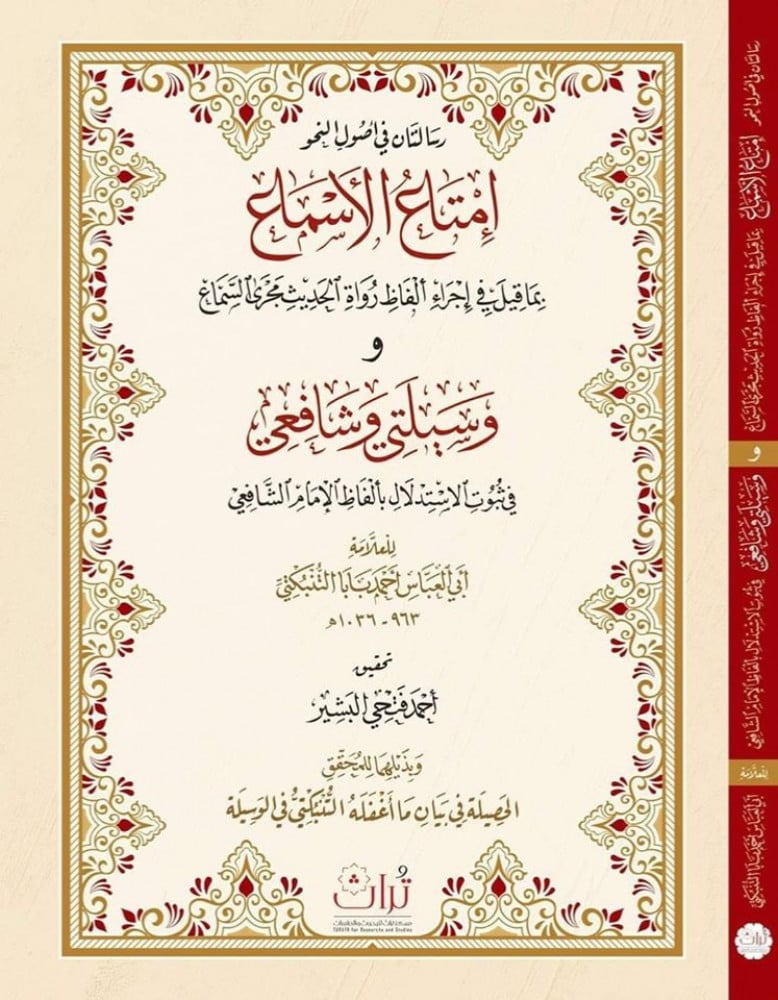
Two messages in the fundamentals of grammar
23.46ر.س
Out of Stock
Product description
The investigator says: [Two Treatises on the Principles of Grammar, by Ahmed Baba al-Tanbukti, with my verification and footnotes authored by me] The first treatise: (Enjoyment of the ears with what was said about making the words of hadith narrators as if heard). In it, Ahmed Baba presents the disagreement that occurred regarding the reliance on the prophetic hadith, mentioning the opinions of most grammarians who discussed this issue and debating them. The importance of the treatise is due to: 1- that he followed the path of the preventers at a time when the doctrine of permissive grammarians was dominant, except for what was from al-Suyuti. 2- that he included all the arguments used by the permissive and discussed them, especially the words of Ibn Khaldun, al-Balqini, and al-Damamini, and the words of Ibn Khaldun and al-Damamini are among the most precise in this matter for the permissive. 3- that he cared about transmitting the words of some commentators on hadith regarding this issue and the words of one of the foundational scholars and discussed them. 4- that he transferred the doctrine of Ibn Hisham on this matter from his book which has not reached us, namely (his explanation of al-Tasheel), and his doctrine in it differs from his apparent doctrine in (Mughni al-Labeeb). The second treatise: (My means and Shafi’i in establishing the validity of proof through the words of Imam al-Shafi’i). It is a valuable rare treatise, due to the following: 1- that it is not in the style of what Az-Zahri, Al-Bayhaqi, and others have followed, claiming that al-Shafi’i was Arab, and that what was taken from his words has a reason and supporting evidence, but rather he discussed the objections raised against the original of his being Arab whose speech is used as evidence, as Ahmed Baba mentioned that some did not rely on the words of al-Shafi’i because he was born in 150, and the grammarians mentioned that the first modern person whose words are not relied upon is Bashar ibn Badr who died in 167 AH, so it is more appropriate not to rely on al-Shafi’i. Also, al-Shafi’i was a resident of the city, and it was stated that speech from urban tribes is not to be taken, and among those who said this, was Abu Hayyan, and al-Shafi’i himself stated that he studied language for twenty years to aid in jurisprudence, and the condition for the Arab who is relied upon in his speech is that his speech be instinctive, not learned. All these objections were presented by Ahmed Baba on the basis of relying on the words of al-Shafi’i. Therefore, Ahmed Baba stated that he wrote this treatise without relying on anyone’s words. 2- During the discussion of these objections, Ahmed Baba transferred from a lost book on the principles of grammar and the rules of reliance by Ibn Abi al-Rabi’, which he mentioned by name, namely (Nihayat al-Mustafeed), and he transferred its rules, which are extremely valuable and rare. 3- In it, Ahmed Baba addressed a matter of utmost importance, which is the era at which reliance on the language of the people of that time stopped, and he explicitly stated that period and transferred the consensus on it. 4- Ahmed Baba also transferred the words of Ibn al-Rabi’ regarding the reliance of Zamakhshari on the poetry of Abu Tammam and the rejection of the readings, which is a precious transfer, although I discussed Ibn al-Rabi’ in this regard in a footnote in the margin of the treatise at its appropriate place. This treatise is more about al-Shafi’i himself than the first in terms of rarity and novelty of the subject, unlike the first treatise, which was generally addressed. Moreover, the treatise on al-Shafi’i precedes the first treatise in the collection that contains both, but I preferred to make the first treatise the first in practice because of the honor of the speaker about the words of his صلى الله عليه وسلم. The third treatise: (The summary in clarifying what Tanbukti neglected in al-Waseela). It is for the poor, and I made it an appendix to Ahmed Baba’s second treatise; as he mentioned the disagreement regarding reliance on the words of al-Shafi’i, without mentioning the names of either side, so I included in this treatise the names of those who deny reliance along with their statements, as well as those who affirm reliance along with their statements. In the second section, I presented four objections to the validity of relying on the words of al-Shafi’i beyond what Ahmed Baba mentioned, some of which I found in the words of those attributed to Arabic, and others from my own, and I discussed them: 1- that al-Shafi’i learned Greek language until he mastered it, as narrated by al-Bayhaqi, al-Abri, and al-Razi, and grammarians have abandoned reliance on the words of those who mixed with non-Arabs, so how about one who learned their language until he mastered it?! 2- that grammarians abandoned citing his words and did not pay attention to transmitting them, as is the case with the sayings of Arabs, their poetry, and other eloquent Arabic speech. 3- that there are grammarians, jurists, and linguists who explicitly tutored al-Shafi’i and took words from him. 4- that many who claim the validity of al-Shafi’i’s words are late Shafi’is. The third section I made to ward off the apparent contradiction that might be perceived from claiming the validity of al-Shafi’i’s words alongside the statement that reliance stopped at the middle of the second century and that it is not taken from the inhabitants of the city, and during this I discussed what is called (doubtful omissions) which some modern scholars hold. In the end, I mentioned what results from the claim of the validity of al-Shafi’i’s words regarding the Arabic language, the principles, and interpretation. Then the expositions come, and thus the work concludes.
