


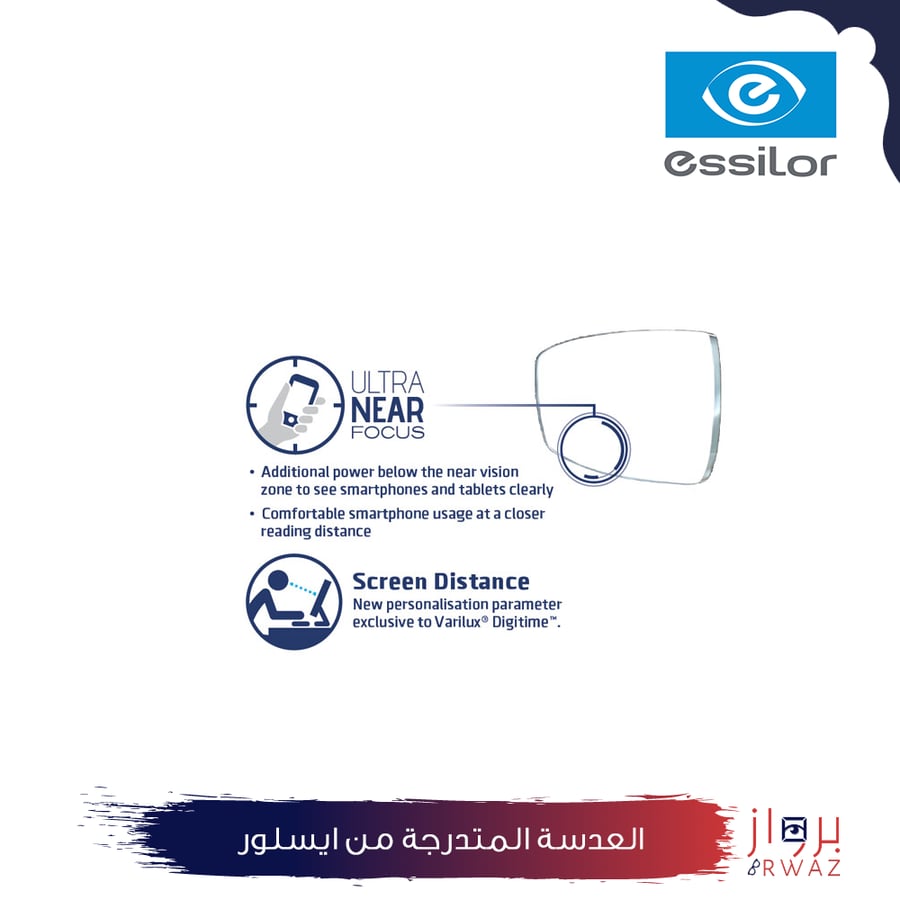

Varilux Lenses from Essilor
420ر.س
Product description
Because at Barwaaz we believe that it is the client's right to know exactly what the lens is made of, we decided to be very precise in displaying the contents of the lens as the first online store to do so, out of appreciation for our customers. Prescription glasses lenses are a "sea" and contain many detailed elements and are not just a size, so we decided to put in extra effort to present all available options before choosing the suitable glasses for you. Important points: Not all options are available with all sizes. After you finish your selection, we will contact you to inform you of the result. If the abundance of options bothers or confuses you, you can simply contact us via WhatsApp so we can choose the most appropriate option for you based on our experience. The final price may change (less or more) if the requested options are not available. Explanation of differences between options: Near and far lens operation method / divided: so that the glasses are divided into two parts, the upper part for distance vision and the lower part for near vision with a clear line visible. Simple graduated: the simple graduated lens that is divided into two parts without a clear line. Special graduated for indoor use: a new idea from Eslor designed for frequent device users, so the glasses are specifically for office use only, with three levels of approximation for mobile, tablet, mobile and computer, mobile and screens. Not suitable for outdoor use as vision will not be clear for distant objects. New basic graduated: the least expensive lens among the new category, similar to the simple graduated but with a wider field of view by 65%. Medium new graduated: 30% higher accuracy than the simple graduated. Advanced new graduated: with a range 78% farther than the simple graduated. Ultra new graduated: it is known that progressive lenses have unclear side vision, but with the ultra progressive lens, vision is clearer at all distances in a 360-degree range. Protection / simple lens: available only for some sizes. Basic protection: available for all sizes. Advanced protection: available for all sizes. Blue light protection: available for all sizes. Night driving protection: a developed technology lens suitable for those who suffer from night driving. Full color layer: the entire lens is colored. Graduated color layer: the top is darker than the bottom. Mirror-like: as if it were a mirror glass. Colors / may not be available with all types of lenses. Lens thickness / it is known that the thickness of prescription lenses increases proportionally with the size of the glasses, so the larger the glasses, the thicker they are. However, in optical factories, there is something called lens pressure, which allows the manufacturer to press the lens as it increases in size to make it look attractive. The challenge is to make the lens beautiful and clear at the same time, so choosing the thickness depends on several factors including the size of the vision correction and the shape of the frame. We at Barwaaz are proud that we pay attention to the smallest details to ensure your glasses look their best and have the clearest image. Glasses sizes / there are five important sizes for prescription glasses that wearers should know: the eye measurement if available, which is either farsightedness indicated by a plus sign or nearsightedness indicated by a minus sign and abbreviated as Sph; the bridge size if available, indicated by a minus sign, usually abbreviated as Cyl; the deviation angle abbreviated as Axis; the addition measurement for near vision indicated by a plus sign and abbreviated as ADD; the distance between the eyes in millimeters, abbreviated as PD. Lens manufacturing: French.
