


PULSAR
1960ر.س
Out of Stock
Product description
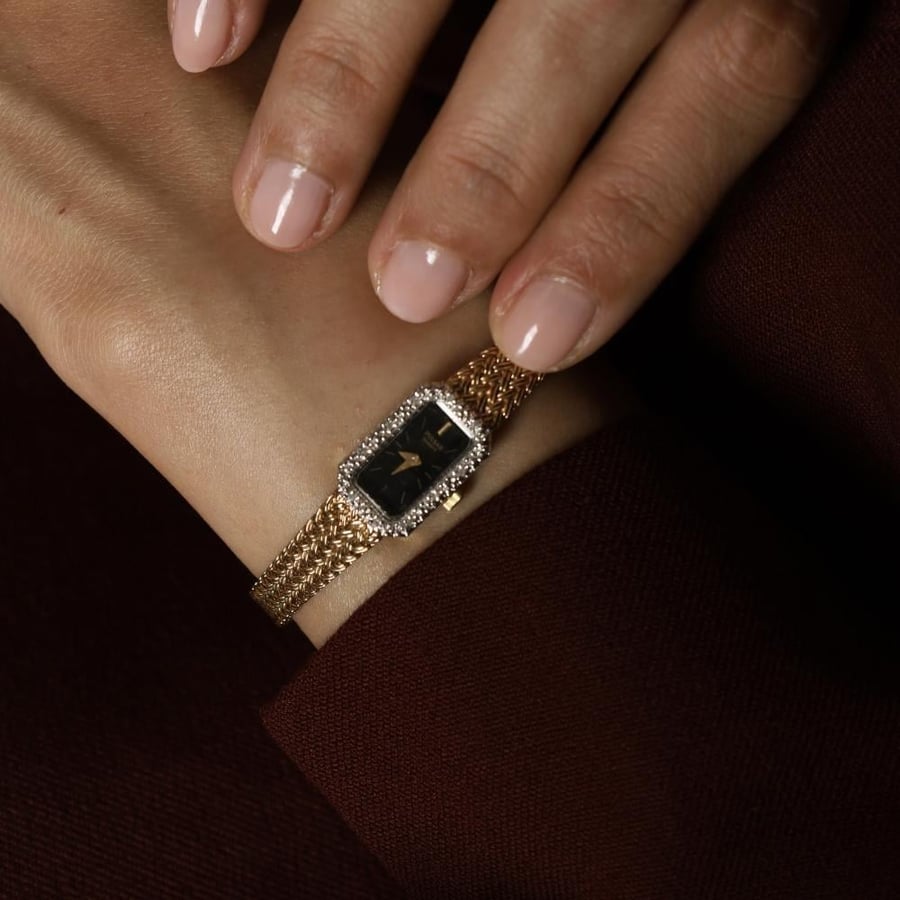
A unique piece from Pulsar, the year 1993, "Tameemah" time wrapping around your wrist. With a diameter not exceeding 11 mm, it embodies true elegance in fine details. A halo of sparkling gems surrounds the dark dial, like stars on a dreamy Japanese night, adding a captivating shine. A woven, golden fabric, meticulously crafted, combines the durability of metal with the elegance of classic "Milani" design. Dark dial with harmonious gold hands and symbols.
PULSAR
The beginning: In 1970, Hamilton announced the launch of a new brand called "Pulsar," which would be the world's first full digital electronic watch. This watch was developed in collaboration with Electro/Data Inc., a small electronics company in Texas, led by George Thiess. The idea was revolutionary: a watch without any moving parts, relying on LED (light-emitting diodes) technology to display digital time instead of traditional hands. The prototype was showcased on "The Tonight Show" with Johnny Carson on May 5, 1970, where it amazed the audience with its high price ($1500 at the time, equivalent to about $11,000 today), prompting Carson to joke that it "will tell you the exact moment you go bankrupt!" This watch was known as "Wrist Computer," utilizing quartz crystal for high accuracy, rechargeable battery, and a button to display the time (short press for hours and minutes, long press for seconds).
Official launch (1972): In spring 1972, Hamilton launched the first commercial Pulsar watch, made of 18-carat gold, priced at $2100 (roughly $16,300 today). This watch was the first full electronic digital watch and caused a huge buzz in the watch world. Thousands of units were sold monthly, surpassing other luxury watch sales. Pulsar was designed to look futuristic, partly inspired by science fiction films like "2001: A Space Odyssey" by Stanley Kubrick, where Hamilton contributed to designing digital watches for the film (although they did not appear in the final version). The name "Pulsar" was inspired by pulsars in astronomy, implying space technology.
Cultural spread (1973): In 1973, James Bond (Roger Moore) wore a Hamilton Pulsar P2 2900 in the film "Live and Let Die," increasing its global fame. The watch appeared in the first scene where Bond presses a button to light up the display. This appearance made it a symbol of modern elegance and technology.
Expansion and innovations (1975): In 1975, Pulsar launched the first integrated digital watch with a calculator, reflecting technological development. Hamilton also established a subsidiary called Time Computer, Inc. to manage Pulsar production, separating it from traditional watch division. However, the success of digital watches led to fierce competition from companies like Casio and Citizen, affecting Hamilton financially. In 1974, Hamilton was sold to SSIH Group (later Swatch Group), while the parent company HMW Industries retained Time Computer, Inc. and Pulsar. Then, in 1978, original Pulsar production ceased due to financial challenges and market changes, and digital facilities were sold to other companies like Rhapsody, Inc. in Philadelphia.
Transition to Japan: Acquisition by Seiko (1980s) – Acquisition (1979-1984): In 1979, Seiko Japanese company purchased the Pulsar brand from Time Computer, Inc., and in 1984, the full acquisition was completed. Seiko sought to expand into the American market and digital technology, and Pulsar became part of Seiko Epson Corporation. This acquisition saved the brand from extinction and revived it under Seiko, which had been a pioneer in quartz technology since the 1970s.
Shift toward quartz watches (1980s): After acquisition, Pulsar gradually shifted from LED digital watches to analog (hands) watches based on Japanese quartz movements. In 1980, Seiko launched a full line of quartz watches for men and women under the Pulsar brand, making it more appealing to the general public. These watches were less expensive and more reliable, utilizing solar energy and precise movements from Miyota, a Seiko subsidiary.
Legacy and importance: Pulsar forever changed the watch industry by introducing digital technology, paving the way for modern electronic watches like smartwatches. It was the first watch without moving parts, and its high accuracy (thanks to quartz) made it more precise than traditional mechanical watches. Despite challenges, it succeeded in building a loyal customer base thanks to Japanese quality under Seiko.

From Taif
Questions you might have