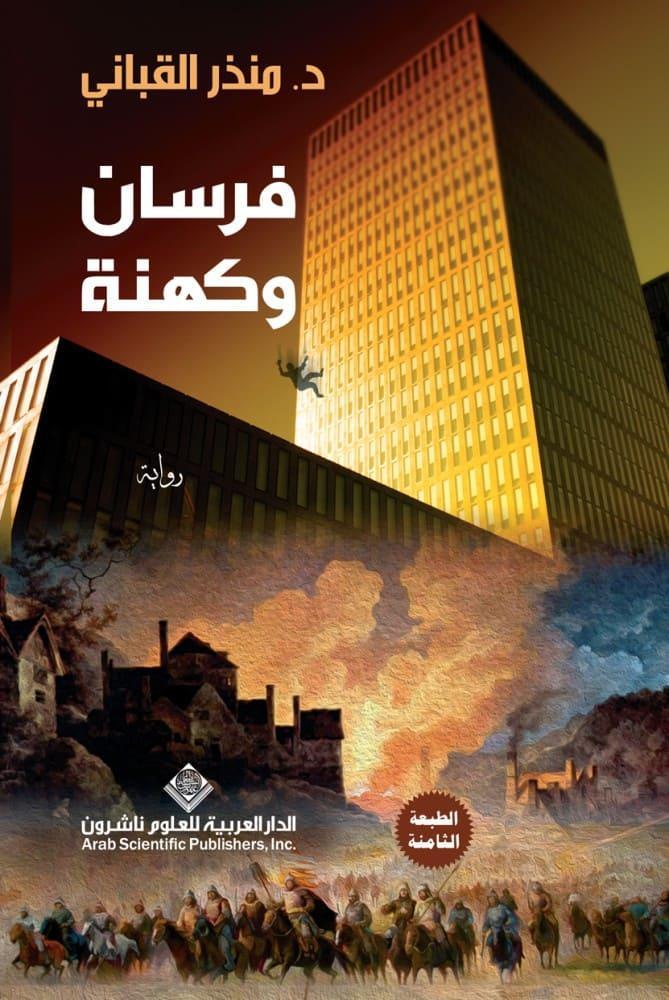
Knights and priests
49ر.س
Buy 2 get 1 free

Product description
Few are the literary works that show the role of literature in history and its connection to a living human experience and its artistic formulation that achieves both enjoyment and benefit. But Dr. Munther Al-Qabbani worked on more than that, when he worked on reviving individual, spatial, and societal memory with elements of reality, documentation, narration, and imagination, so all the elements that regulate the dialectical relationship between man on one hand and history and narrative creativity on the other gathered. And the trilogy "Knights and Priests" was the new novel project in its temporal structure, spatial space, and characters, closer to truth and reality. The novelist built his events from the central truth of the event (the existence of Commander Genghis Khan as a real historical figure) to the imagined and supposed event woven to realize this reality or create its parallel world (the truth of the existence of Dr. Murad Qutuz in life and his truth of transition to the other world), so the event was like watching a film strip in which the reader is not subjected to standards of time and place, but the novelist leaves him free to watch the events from any angle he sees fit and even the freedom to move between these events and their different angles. Sometimes he finds himself in front of the barbarity of the Mongols in the twelfth century and other times in the twenty-first century following a network of intertwined social relations in a velvet society that includes masters and slaves in a palace from the palaces of Riyadh. This is what made the novelist move his characters through time as if they are moving or time is moving around them.
Book information:
Author: Munther Qabbani
Number of pages: 280
Publisher: Dar Al-Arabia for Sciences

Questions you might have