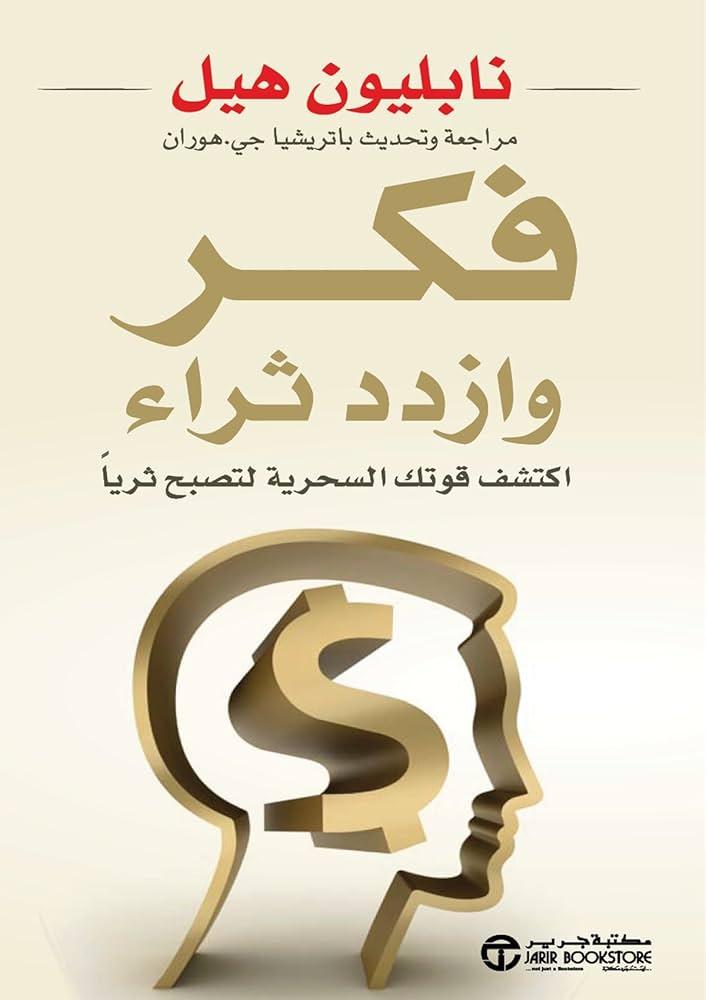
Think and increase wealth
59ر.س
Product description
When this book was published in 1937, it was considered one of the most inspiring books of its time. Alongside "How to Win Friends and Influence People" by Dale Carnegie and "The Power of Positive Thinking" by Norman Vincent Peale, everyone seeking success in their personal or professional life, whether men or women, read this book. More than 15 million copies of this book have been sold, and it became a roadmap for millions of people to escape the poverty of the Great Depression era and attain prosperity for themselves and their families, and in many cases, for their employees. Who is "Napoleon Hill"? And what is the source of his philosophy? Napoleon Hill was born into a poor family in 1883 in a one-room house in rural Virginia. He became an orphan at the age of twelve, and his relatives took responsibility for his upbringing. To overcome his poverty and rebellious nature, he struggled to learn and became one of the practical geniuses of his era. At thirteen, he began his career as a writer, working part-time as a reporter for a small village newspaper — a correspondent writing stories about what was happening in his area for a few cents per line. Perhaps because of his struggle to fight poverty, he became obsessed with the reason why people fail to achieve real material success and happiness in their lives. To make a living, he chose to work in law and journalism, and his early job as a reporter helped him cover the expenses of his law school studies. His big opportunity came when he was tasked with writing a series of success stories of famous people. One of the people he met was "Andrew Carnegie," a renowned steel magnate in the world. Mr. Carnegie was very impressed with the young journalist that he entrusted him with a task that would dedicate the next twenty years of Hill's life. The project was to conduct interviews with more than 500 millionaires to find a success formula that an ordinary person could use. Among these interviews were with the wealthiest and greatest men of his era, including "Thomas Edison," "Alexander Graham Bell," "Henry Ford," "Charles M. Schwab," "Theodore Roosevelt," "William Rigley Jr.," "John Wanamaker," "William Jennings Bryan," "George Eastman," "Woodrow Wilson," "William H. Taft," "John D. Rockefeller," "F. W. Woolworth," and others who are not as famous today. During this period, "Andrew Carnegie" was Hill's mentor, helping him develop a success formula based on the ideas and experiences of the people he interviewed.
Book information:
Author: Napoleon Hill
Publisher: Jarir Bookstore
Pages: 233
