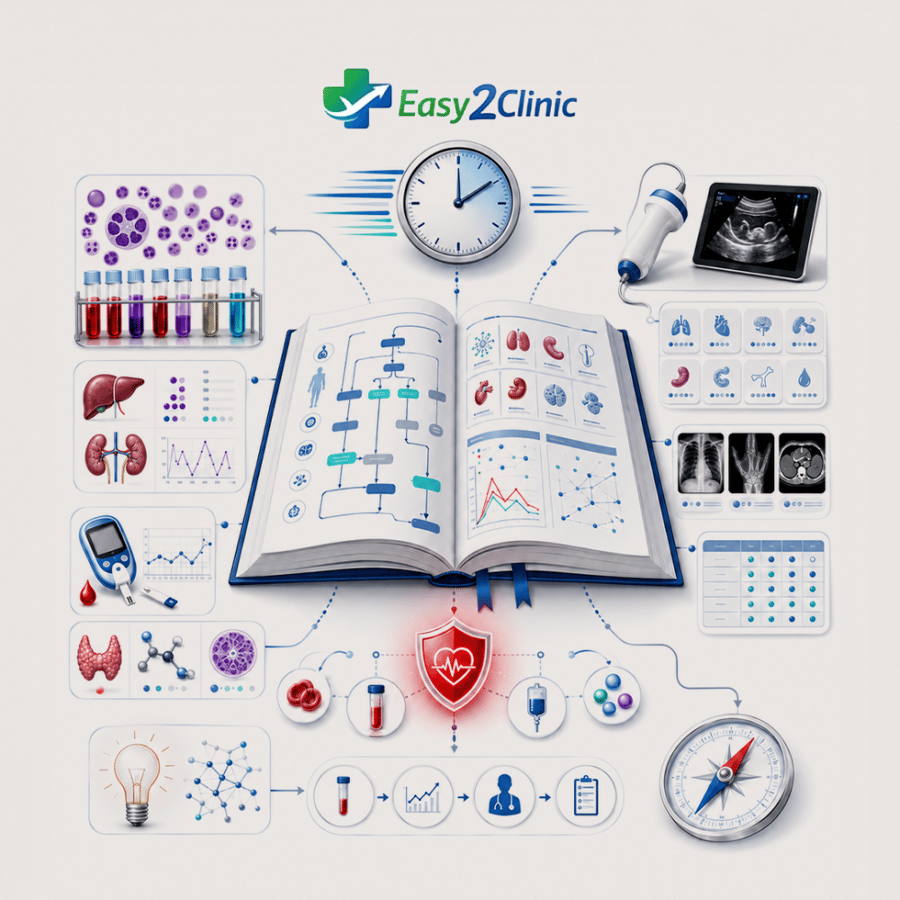
Primary Care Diagnostic Handbook
59ر.س
74ر.س-20%Product description
The Primary Care Diagnostic Handbook is a practical, quick-reference clinical resource designed to help doctors and healthcare professionals interpret investigations, review diagnostic classifications, and approach abnormal findings in a more structured and efficient way.
During a busy clinic day, knowing the normal reference range is often not enough. Clinicians also need to understand what the result means within the patient’s clinical context and determine the next step: routine follow-up, additional testing, urgent assessment, or referral.
The handbook organizes essential diagnostic information into a clear, visually structured format that can be used during consultations, case reviews, and time-sensitive clinical decisions.
What Is the Primary Care Diagnostic Handbook?
The handbook is a concise and organized clinical reference developed to simplify access to diagnostic information used in everyday primary care practice.
Rather than presenting reference ranges alone, it helps clinicians move from a test result to the next clinical consideration through practical tables, structured algorithms, and alerts for findings that may require urgent attention.
What Does the Handbook Include?
The handbook covers commonly requested investigations and diagnostic systems used in primary care, with information arranged for quick review during clinical practice.
Common Laboratory Test Interpretation
The handbook provides practical guidance for interpreting:
- Complete blood count.
- Renal function tests.
- Liver function tests.
- Lipid profiles.
- Diabetes-related results and diagnostic criteria.
- Thyroid function tests.
- Selected vitamin deficiencies.
- Electrolyte abnormalities and other significant findings.
It highlights the clinical significance of important results and the factors clinicians should consider before deciding on the next step.
Ultrasound and Diagnostic Classifications
The handbook includes selected point-of-care ultrasound references alongside summaries of commonly used imaging and diagnostic classifications, including:
- ACR TI-RADS for the ultrasound-based assessment of thyroid nodules.
- BI-RADS for understanding standardized breast imaging categories.
- DXA, also commonly referred to as DEXA, for bone density assessment.
- Classifications used when evaluating reduced bone density and osteoporosis.
Structured charts make these systems easier to review without requiring clinicians to memorize every scoring detail.
Critical Laboratory Values
A dedicated section focuses on critical findings that may indicate a significant clinical risk and require rapid assessment.
This section includes:
- Recognition of results requiring urgent attention.
- Important electrolyte abnormalities.
- Assessment of severe hypo- and hyperkalemia.
- Structured initial considerations for critical results.
- Identification of cases that may require immediate management or urgent referral.
Critical values should always be interpreted alongside the patient’s condition and locally approved clinical protocols.
Clinical Pearls and Test Interferences
Laboratory results may be influenced by the patient’s medical condition, medications, supplements, or the testing method used.
The handbook highlights important considerations, including:
- The possible association between iron deficiency and higher HbA1c values in some patients.
- The potential for biotin supplements to interfere with certain immunoassays, including some thyroid function tests.
- The importance of avoiding interpretation of an isolated result without reviewing symptoms, medical history, and related investigations.
- Less obvious factors that may contribute to unexpected or potentially misleading results.
Why Do Clinicians Need This Handbook?
The Primary Care Diagnostic Handbook was created for situations where clinicians need reliable and clearly organized information within a limited amount of time.
It can help clinicians:
- Save time when reviewing investigation results.
- Apply a structured approach to laboratory interpretation.
- Move from a result to the next clinical consideration.
- Recognize critical values and warning signs.
- Support diagnostic reasoning and clinical decisions.
- Identify patients who may need additional investigations.
- Recognize cases that may require referral.
- Reduce time spent searching across lengthy and fragmented references.
Practical Tools Inside the Handbook
The handbook presents its content through clinic-friendly tools, including:
- Structured clinical algorithms.
- Quick-reference interpretation tables.
- Summaries of diagnostic classification systems.
- Critical laboratory value alerts.
- Clear pathways from a test result to the next consideration.
- Clinical pearls highlighting common interpretation pitfalls.
- Visually organized formatting for quick navigation.
Areas Covered by the Handbook
The Primary Care Diagnostic Handbook covers important areas of primary care practice, including:
- Hematology and CBC interpretation.
- Renal function and electrolyte abnormalities.
- Liver function.
- Lipid disorders.
- Diabetes diagnosis and related results.
- Thyroid disorders.
- Vitamin deficiencies.
- Thyroid nodules.
- Breast imaging categories.
- Bone density and osteoporosis assessment.
- Critical laboratory values.
- Factors that may affect laboratory test accuracy.
Who Is the Primary Care Diagnostic Handbook For?
The handbook is suitable for:
- General practitioners.
- Family physicians.
- Primary care doctors.
- Residents.
- Medical interns.
- Medical students in their clinical years.
- Healthcare professionals who need a practical reference for test interpretation and clinical decision support.
Frequently Asked Questions
Does the handbook only provide normal laboratory ranges?
No. The handbook goes beyond reference ranges by providing structured pathways and practical guidance to help clinicians interpret findings and review the next clinical consideration.
Which common laboratory tests are included?
The handbook covers commonly used investigations such as CBC, renal and liver function tests, lipid profiles, diabetes-related tests, and thyroid function tests.
Does the handbook include imaging classifications?
Yes. It provides summaries of selected diagnostic classifications, including ACR TI-RADS, BI-RADS, and DXA or DEXA interpretation.
Does the handbook replace professional clinical judgment?
No. The handbook is designed to support clinical decision-making and improve access to organized information. It does not replace a complete medical assessment, professional judgment, or locally approved clinical protocols.
Move From Test Result to Next Step With Greater Clarity
When you need a structured resource for interpreting investigations, reviewing diagnostic classifications, and recognizing findings that require further action, the Primary Care Diagnostic Handbook provides practical content designed for everyday clinical practice.
Spend less time searching, organize your clinical assessment, and access essential diagnostic information when you need it.
Available now on Easy2Clinic.
