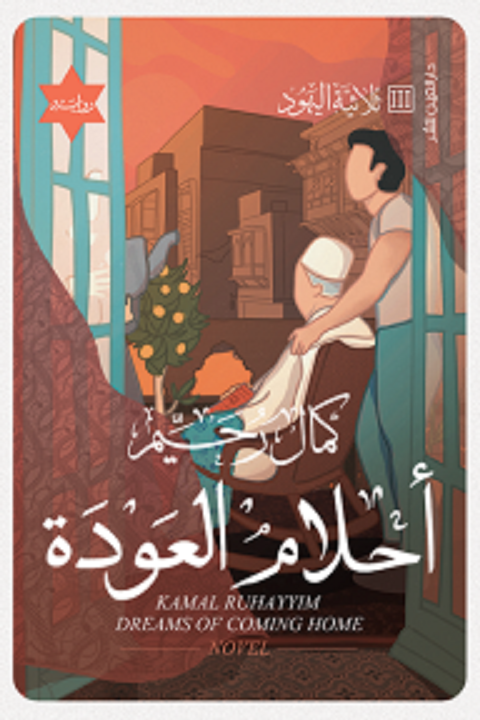
Dreams of Return: The Jewish Trilogy III
19.55ر.س
39.1ر.س-50%Product description
Book title: Dreams of Return Trilogy of the Jews III
Author: Kamal Rahimdar
Publisher: Dar Al-Ain for Publishing
Number of pages: 313
Book genre: Novel
Brief about the book: The novel is the last part of the trilogy by novelist Kamal Rahim after the publication of the novel Days of Dispersion in Arabic, English translation, and German translation, and Kamal Rahim is considered one of the most important and distinguished creators and novelists who left their mark over recent years on the map of Arabic novels. Dreams of Return is a novel that completes an important literary project initiated by the novelist several years ago.
The events of the novel revolve around a child named "Jalal" born in the middle of the last century in one of Cairo's old neighborhoods to a Muslim father and a Jewish mother. His father died in the Suez War in 1956, and the child was still in his mother’s womb, so his Jewish family took care of him and raised him. He lives in a state of conflict between Judaism, which his mother’s family practices, and Islam, which he follows.
This novel is the first part of an autobiographical epic that covers the life of this boy "Jalal" in three parts. The second part is "Days of Dispersion," and the third part is set to be published at the beginning of next year.
The second part tells about the material and moral dispersion that Jalal, the protagonist, and all his family members suffered from, in one way or another, due to the idea of leaving Egypt.
Jalal begins to work hard to earn a living, and events lead him to connect with a Lebanese man, and they work together in the clothing trade until two major events happen in Egypt: President Sadat’s visit to Jerusalem and his assassination. These had a significant impact on revealing his true self toward his homeland, which appeared in his heated dialogues and discussions with these migrants, as well as what he noticed about the effect of these two events on the Jewish community, some of whom, including his grandfather, thought the problem was solved and that they would return to Egypt.
The death of his grandfather had a great impact on Jalal; he discovered that he had become an orphan, as this tolerant man was like a father and mother at the same time. It seemed to him that he was the refuge and homeland he sought in his exile. After his death, he had no choice but to return to Egypt after many years spent as a stranger in France.

From Riyadh
Questions you might have