

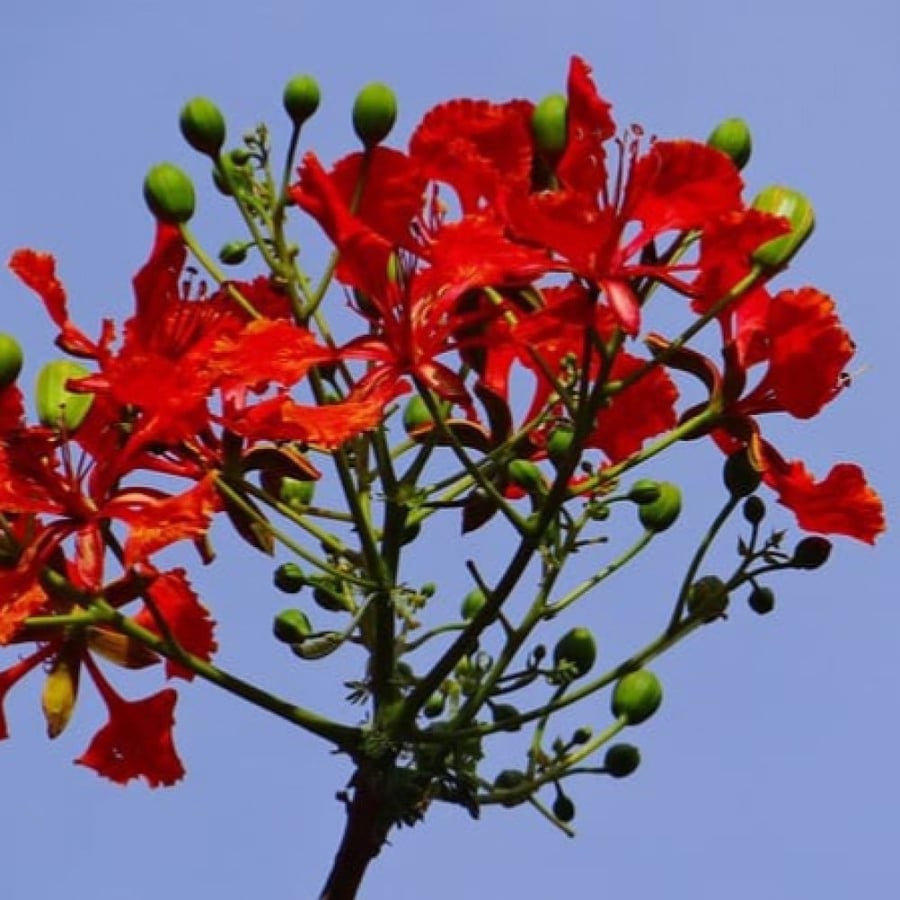


Red Delonix regia seeds
7ر.س
Product description
Common name: Red Delonix
Scientific name: Delonix regia
Also known as: Royal Flame - Glowing - Royal Delonix
It is a decorative and shade tree, with compound, deciduous, feathery leaves. It grows relatively quickly, reaching a height of 15-18 meters, with smooth bark. Delonix trees are not hindered by cement, sidewalks, or buildings, as their roots can push upward through what is above them. The tree's crown has a geometric shape, composed of fragile branches that can break easily due to strong winds.
Red Delonix flower:
The flowers are summer blooms, appearing in large, beautiful clusters that look small compared to their long stamens. The inflorescences with light crimson color appear from the age of 10 years, but most often they are red and orange.
Fruit and seeds of the Red Delonix:
Its fruits are pod-like, measuring between 20 cm and 30 cm, dark brown in color, and are toxic.
Season for propagating the Red Delonix:
It is planted in early spring or summer, and can also be cultivated year-round in agricultural nurseries, enclosed spaces, or plastic greenhouses where temperature can be controlled, sunlight reaches the plant, or where adequate lighting is available.
Suitable climate and soil for the Red Delonix:
It is grown in fertile, well-drained, and ventilated soil. It does not tolerate frost, is sensitive to drought, and prefers a pH around 1500 parts per million.
Method of cultivating the Red Delonix:
It is propagated by seeds and transplanting seedlings at a depth of at least 1 to 2 cm. It needs daily watering because it loves water. It germinates shortly after planting. It can be cultivated year-round in nurseries, enclosed spaces, or plastic greenhouses where temperature and sunlight can be controlled, or where adequate lighting is available.
Its benefits and uses:
Delonix trees are used for decoration along roads, in large gardens, and parks due to their beauty and striking appearance.
Original habitat of the Red Delonix:
Its native homeland is Madagascar and tropical and subtropical regions, but it is now widespread in many parts of the world.

From Buraydah