


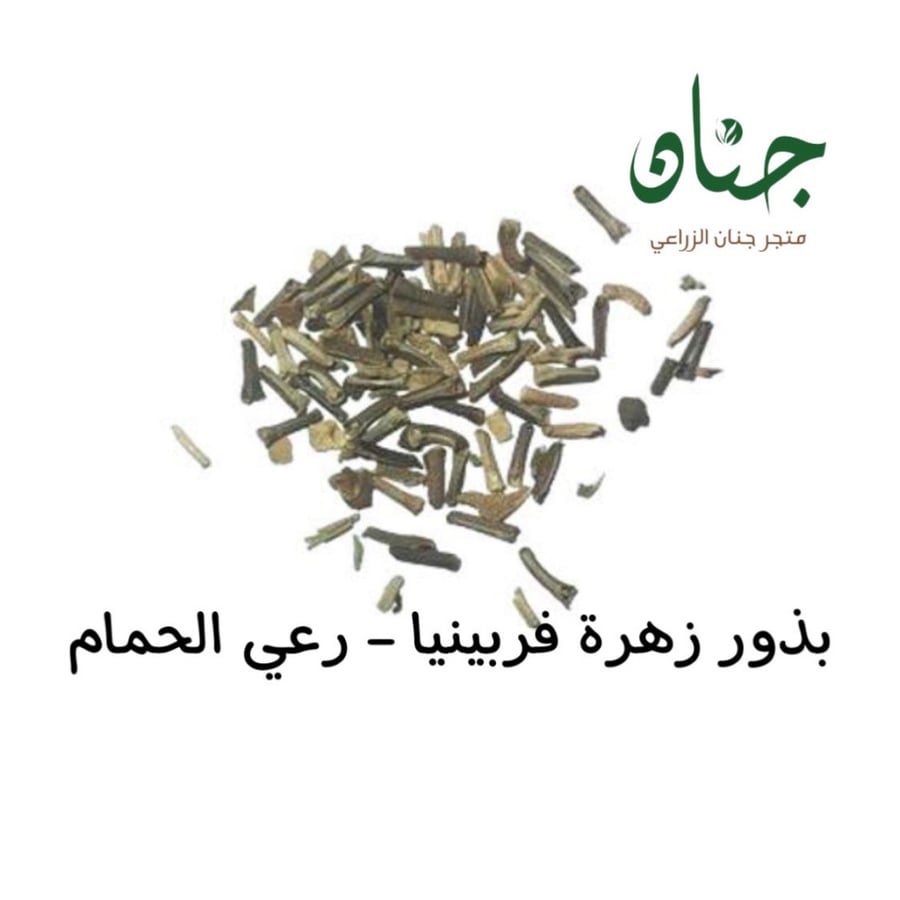
Verbena officinalis seeds - Birdfennel grazing
6ر.س
Product description
Common name: Verbena
Scientific name: Verbena officinalis
Also known as: Rahi Al-Hamam
Perennial herbaceous plant that appears as a ground cover, fast-growing, with evergreen leaves divided into small soft parts, reaching a height of 70 cm.
- Verbena - Rahi Al-Hamam:
The flowers are tubular and borne in terminal clusters. The flowers appear in spring in shades of white, light purple, purple, and violet.
- Seeds of Verbena - Rahi Al-Hamam:
The seeds come inside small boxes measuring about 0.2 cm.
- Propagation season of Verbena - Rahi Al-Hamam:
Seeds are planted from September to November, and cuttings and layering in January and February. It can also be cultivated year-round in agricultural shelters and enclosed or plastic places where temperature and sunlight can be controlled, or where the necessary lighting for the plant is available.
- Suitable climate and soil for Verbena - Rahi Al-Hamam:
The plant thrives in fertile, well-drained soil, whether exposed to full sun or partial shade. It tolerates heat in open spaces if watered frequently. It can be used as an ornamental plant with regular watering.
- How to cultivate Verbena - Rahi Al-Hamam:
Seeds are evenly distributed on the soil surface at a depth of 1-2 cm in boxes or cells. After two weeks, thin green sprouts form in rows.
- Its benefits and uses:
Helps stabilize the soil and cover slopes and inclines. It is a drought-resistant plant and abundant in flowering. It grows easily indoors and provides an elegant and beautiful appearance for windows. It has multiple medicinal uses, but it contains some toxicity, so caution should be taken to prevent cats and animals from eating it.
- Native habitat of Verbena - Rahi Al-Hamam:
Originally from Europe, Asia, and North Africa. It is also cultivated in Saudi Arabia and the Gulf countries.

From Buraydah