
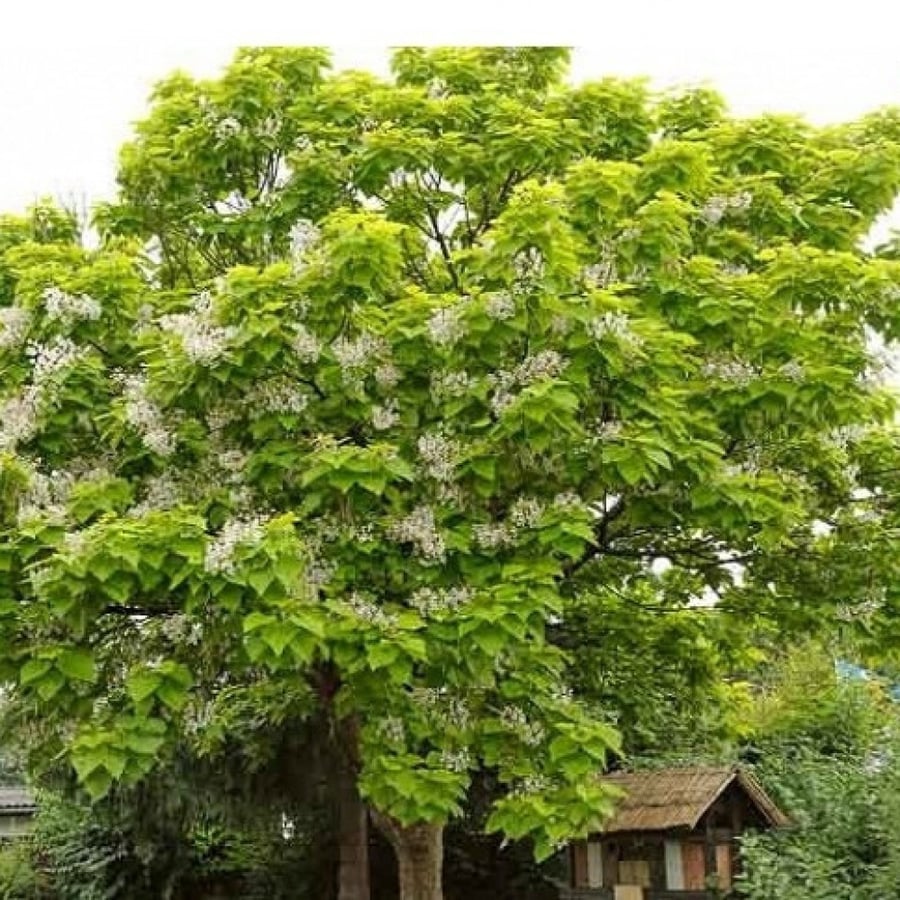



Catalpa tree seeds, peanut (Catalpa bignonioides)
8ر.س
Product description
Common name: Catalpa Foul Indian
Scientific name: Catalpa bignonioides
Other names: Southern Catalpa - Bignonioides Catalpa
A tree from the Catalpa genus of the Bignoniaceae family that reaches a height of up to 18 meters, with large, light green, oval-shaped leaves. It is a flowering tree characterized by its lush shade, making it an attractive habitat for birds, and its beautiful white fragrant flowers that attract bees.
Flowers of the Indian Foul Catalpa tree:
Their flowers are white, bell-shaped, up to 4 cm in diameter, forming attractive clusters, and they bloom in spring and summer.
Seeds and fruit of the Indian Foul Catalpa tree:
Its seeds are elongated, feather-like, and white with a brownish tint, contained within long pods that exceed 30 cm in length.
Season for germinating the Indian Foul Catalpa tree:
It is planted outdoors in autumn and spring, and can also be cultivated year-round in agricultural protected environments, enclosed or plastic places where temperature can be controlled, sunlight is available, or where adequate lighting for the plant exists.
Suitable climate and soil for cultivating the Indian Foul Catalpa tree:
It requires a sunny environment, can tolerate hot climates, but it is recommended to plant it in a semi-shaded area until it surpasses 3 years of age. It is a deciduous tree in winter, then returns to dense green foliage with decreasing temperatures. It can adapt to most soil types but thrives in fertile, well-drained soil.
Method of cultivating the Indian Foul Catalpa tree:
It propagates through cuttings or seeds planted at a depth of 1 cm. It is considered a high germination rate and fast-growing tree.
Benefits and uses:
It is planted for decoration in homes, gardens, and parks due to its beauty and shape. Its wood is also used in manufacturing some products.
Original habitat of the Indian Foul Catalpa tree:
Southeastern United States.

From Buraydah