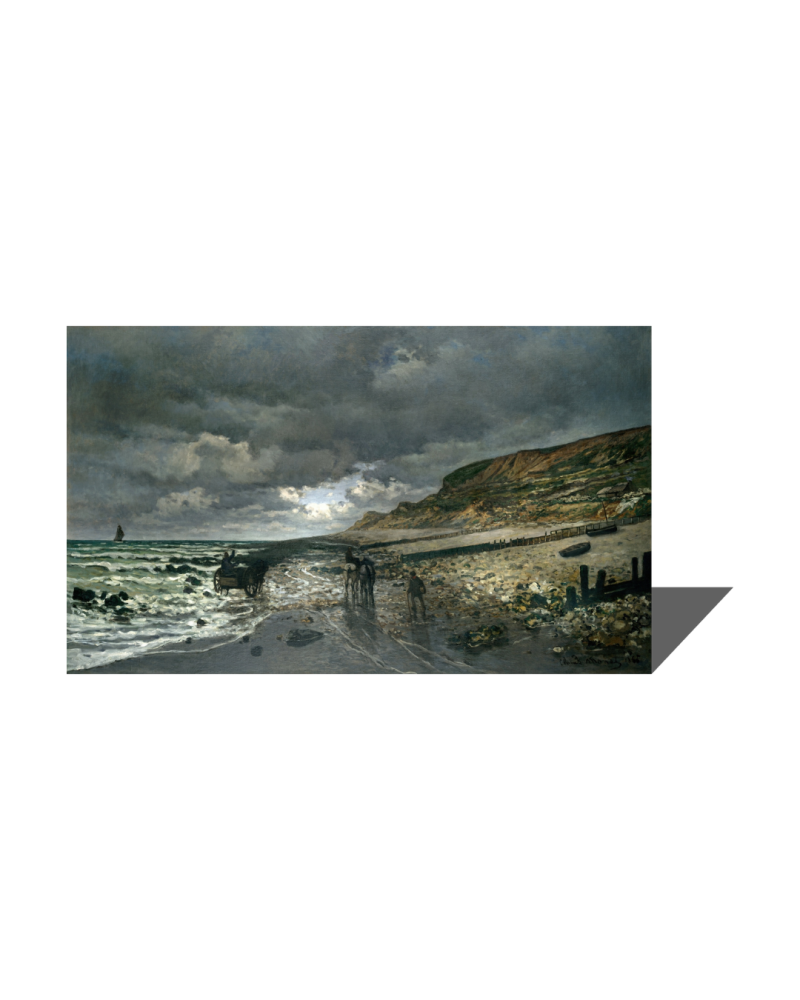

The dry one at the islands
224.99ر.س
Product description
This painting depicts the French coast near the "Ras Al-Hayf" area, close to Le Havre, at the moment of a sea storm. We see a flat sandy beach scattered with rocks and sea trenches, with small fishing boats appearing on the distant horizon. The sky is cloudy, overcast with gray clouds leaning toward blue, giving the scene a cold and majestic atmosphere that reflects the beauty and mysterious stillness of nature. In the horizon, the meeting of the sea and sky emerges in a mesmerizing play of light, where Monet manipulates shades of blue, brown, and gray in a way that foreshadows the beginnings of his Impressionist style, which would later become a landmark in modern art history. Artistic significance: This is one of the first paintings Monet exhibited at the "Paris Salon" in 1865, marking his actual launch into the art world. Monet used plein air painting to express the changing light and atmosphere with truthful and realistic details. The painting is characterized by conveying a silent feeling, ranging between solitude and peace, which later became a hallmark of Monet's maritime works. The painting shows Monet's respect for nature and his attraction to the changing scenes of light and water. Despite the simplicity of the subject, the painting conveys a deep sense of contemplation and tranquility, where time stops and nature becomes the only speaker.

From Riyadh
Questions you might have