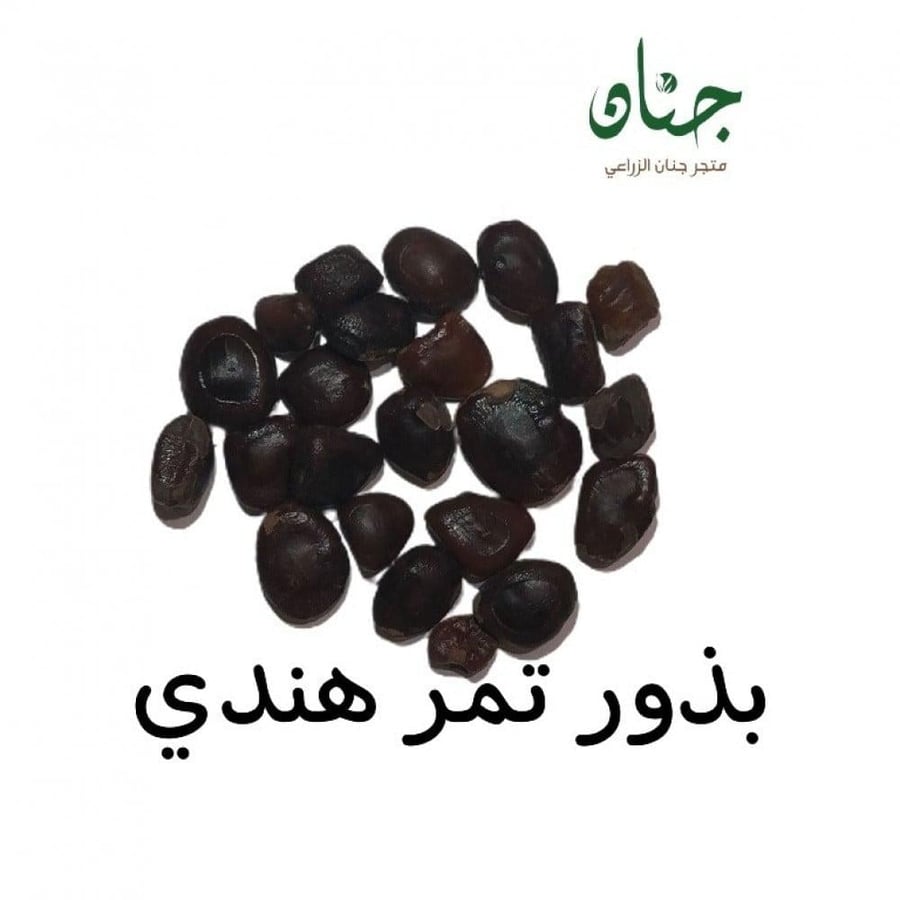
Tamarind tree seeds (Tamarindus indica)
6ر.س
Product description
Common name: Tamarind tree
Scientific name: Tamarindus indica
Among its names: Al-ardib
A large tree reaching up to 20 meters in height, with a dense round canopy, a short thick trunk, and drooping branches. Its leaves are compound, pinnate, shiny, oval-shaped, containing 10-18 pairs of elongated leaflets that fold at night.
Tamarind tree flowers: The flowers are in small cluster inflorescences, long, red and yellow, blooming from March to May.
Tamarind fruit and seeds: The fruit is enclosed between the seeds, meaning the diameter of the fruit is very narrow between the seeds. The seed is surrounded by a sweet and sour fleshy pulp. Its size is 15 cm – 20 cm.
Tamarind tree planting season: Tamarind is planted at the beginning of the spring season, and it can also be cultivated year-round in agricultural protected areas and enclosed or plastic places where temperature can be controlled, sunlight reaches, or where adequate lighting for the plant is available.
Suitable climate and soil for planting tamarind: It grows well under full sunlight in clay, silty, deep loamy soils, acidic soils, and calcareous soils. It is sensitive to frost and small trees should be protected from cold. Although highly drought-resistant, it requires regular watering.
How to cultivate tamarind: Propagation is done through cuttings and aerial layering, in addition to seeds that are planted in the soil at a depth of 1 cm to 2 cm.
Its benefits and uses: It has several uses, including as an ornamental tree for shade, as a roadside tree, and as a single specimen. It is widely used in parks.
Original habitat of the tamarind tree: Its native regions are Africa and Southeast Asia.

From Buraydah
Questions you might have