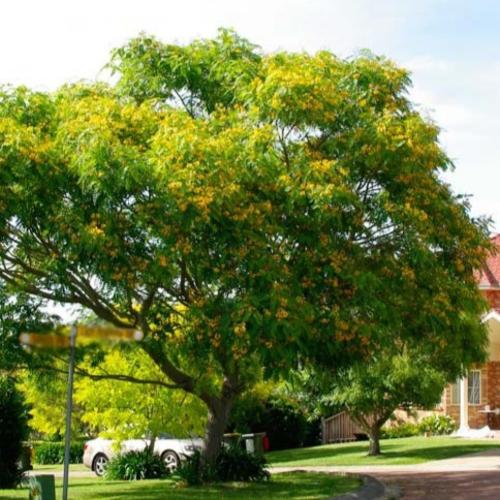
Peruvian pepper tree seeds with thin leaves (Schinus molle)
6ر.س
Product description
Common name: Peruvian pepper with thin leaves
Scientific name: Schinus molle
Also known as: American pepper - false pepper
The Peruvian pepper tree is an evergreen tree that reaches up to 15 meters in height, with a diameter ranging from 25 to 35 cm. It has an open canopy resembling an umbrella, and the leaves are alternate, evergreen, pinnate, with a complete margin, rhombic to oval in shape. It is used to produce pink pepper. Despite its name, the pink pepper is a false pepper and is not related to black pepper. It has a strong aromatic scent when its leaves are rubbed, similar to the smell of fresh mango.
• Flowers of the Peruvian pepper with thin leaves: small white flowers borne in clusters that can reach between 5 cm and 15 cm in size, blooming from March to May.
• Fruit and seeds of the Peruvian pepper with thin leaves: pink berries resembling peppercorns, measuring between 0.5 cm and 0.7 cm, containing a seed inside.
• Propagation season of the Peruvian pepper with thin leaves: it is cultivated at the end of winter, and can also be grown year-round in protected agricultural environments, enclosed or plastic-covered areas where temperature can be controlled, and where plants receive adequate sunlight.
• Suitable climate and soil for the Peruvian pepper with thin leaves: the plant requires full sunlight with some humidity, regular watering, and tolerates moderate salinity. It thrives in most well-drained soils but is not highly tolerant overall. It can withstand temperatures as low as 5°C but is sensitive to cold, dry winds. The plant is suitable for areas that do not experience frost.
• Method of cultivation of the Peruvian pepper with thin leaves: propagated by seeds or cuttings.
• Uses and benefits: The pink seeds are used as a spice instead of black pepper, and also as an analgesic, anti-inflammatory, antibacterial, antiviral, diuretic, wound healer, and beneficial for chest infections. It is also an ornamental and shade tree.
• Native habitat of the Peruvian pepper with thin leaves: native to South America, specifically Peru, and also found in tropical and subtropical regions worldwide. It is cultivated in Saudi Arabia and the Gulf countries.

From Buraydah